Reservoir

As Egypt’s largest oil and gas investor, Eni is ramping up its 2026–2027 drilling campaign with new investments cross the Mediterranean offshore, Nile Delta, Western Desert, and offshore Sinai to strengthen the country’s role as a regional gas and LNG export hub.

The industry is no longer short of measurements; the real challenge is converting them into timely reservoir decisions that protect value. That challenge is becoming more urgent as the industry depends increasingly on mature fields and existing infrastructure. The selected papers show how this need is being addressed across different producing regions.

This paper presents a case study from a mature field redevelopment project where pulsed neutron logging was integrated with advanced reservoir modeling to improve the understanding of fluid-contact dynamics and optimize new horizontal well placement.
-
 In this paper, two different EGR methods are investigated and systematically compared in terms of efficiency.
 -
A normal five-spot polymer-flooding pilot has been conducted at the Mangala field, one of the largest onshore fields in India, and results are encouraging
-
Several studies explored the possibility of improving both areal and vertical sweep efficiency in mature water-alternating-gas (WAG) patterns in the Magnus oil field.
-
Foams have proved to be efficient at temporarily blocking high-conductivity layers and improving gas-injection conformance and sweep efficiency in predominantly matrix reservoir systems, at least in laboratory and field pilot tests.
-
What a difference a year can make! Back in June 2014, when the EOR Operations feature last appeared in JPT, Brent was trading at more than USD 100/bbl.
-
This paper presents performance, results, and learnings from the first solar enhanced-oil-recovery (EOR) project in the Middle East/North Africa region
-
A new miniature pressure/temperature sensor comes packaged inside a tough small ball capable of traveling to the bottom of a well while drilling and returning with data on board.
-
A project to predict how much carbon dioxide injected into an oil field is likely to remain there forever set off the US Department of Energy (DOE) on a search for faster data analysis methods.
-
When it comes to fracturing, experts argue about many things, but they agree that fractures do not look like lightning bolts, tree roots, or shattered glass.
-
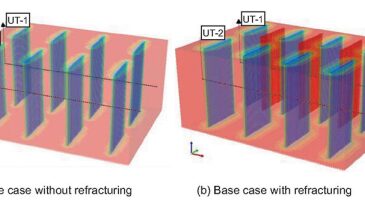
As shale operators look for ways to survive amid the current downturn in oil prices, accelerating the refracturing of older horizontal wells is turning into one of the most attractive options.