Floating production systems

This paper explores the application of a modular, high-temperature gas-cooled nuclear reactor to a Very Large Crude Carrier-class floating production, storage, and offloading vessel.

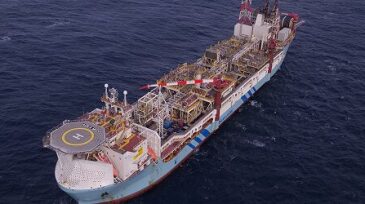
After launching pre-salt production in Brazil, the ultradeepwater Tupi asset has become one of Petrobras’s most productive.
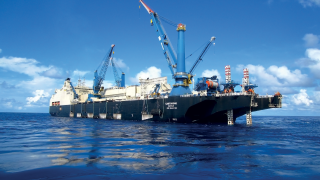
The $5.1 billion ultradeepwater project is Angola’s first integrated cross-block development and sits at the top of Azule’s Southern African portfolio.
-
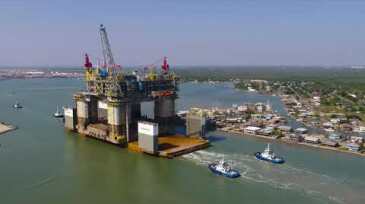
 BP’s Argos platform is part of the $9-billion Mad Dog project in the US Gulf of Mexico.
 -
The Japanese contractor received word in early April it would be temporarily banned from new competitive bidding.
-
The paper details the fast-tracking of a 450-km floating liquefied natural gas unit relocation from Sarawak to Sabah offshore Malaysia. The time from selecting the new field to unloading LNG at the new location was 13 months.
-
With all critical components nearly in place, production is set to start this year at the Lingshui 17-2, China’s first ultradeepwater gasfield development project.
-
With a replacement gas injection system successfully installed, the Liza Destiny FPSO has reached its peak capacity of 120,000 B/D on the one-year anniversary of its commissioning.
-
Modules for the FPSO will travel to Singapore for integration. The FPSO will be located offshore Mexico, with first oil production planned for 2021.
-
Petrobras began negotiations with SBM Offshore to contract the floating production, storage, and offloading (FPSO) Almirante Tamandaré to be installed in the Búzios field in the Santos Basin.
-
DNV GL and floating production, storage, and offloading (FPSO) vessel specialist Bluewater are undertaking a pilot project to use hybrid digital twin technology to predict and analyze fatigue in the hull of an FPSO in the North Sea.
-
The FPSO will be capable of processing 90,000 B/D of crude, 75 million ft3/D, 120,000 B/D of water injection, and a storage capacity of 900,000 bbl of crude oil. First oil is planned for 2021.
-
The complete paper provides insight on the commercial drivers that significantly changed floating-production-system (FPS) design philosophy after 2014, with a particular focus on the US Gulf of Mexico (GOM).