Unconventional/complex reservoirs

Disposal wells remain the lowest-cost solution for produced water, but concerns over seismicity and long-term sustainability are accelerating interest in alternatives.

This work applies fuzzy logic, a well-established artificial-intelligence technique, to quantitatively assess connectivity between injectors and producers in a giant presalt field in the Santos Basin of Brazil.

With a strong presence across US shale in the Bakken, Anadarko Basin, Powder River Basin, and the Permian, Continental Resources is expanding into Argentina’s Vaca Muerta shale as the privately held E&P giant pursues international growth.
-
 Strathcona doubles down on heavy oil—sells Montney assets for nearly CAD 3 billion, grabs Canada’s top crude-by-rail hub, and sets sights on MEG Energy in bold growth move.
 -
This article presents a comparative study evaluating four machine-learning approaches, including three deep-learning methods, for forecasting gas and condensate production over a 5-year horizon.
-
US shale producers have stepped up their use of simultaneous fracturing techniques to cut costs and accelerate well delivery.
-
This paper highlights nontraditional methods to cure oil-based-mud losses in horizontal wells drilled in unconventional plays.
-
Natural gas-powered electric fleets look to pave the way for the next generation of power generation.
-
Field examples from the Bakken Shale and Permian Basin illustrate the benefits of deploying polymer-coated and uncoated scale inhibitors in unconventional wells.
-
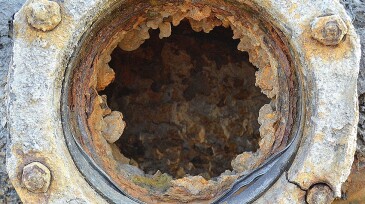
New strategies for protecting metal infrastructure emerge as operators fine-tune a corrosion threat screening process and develop a new method for tracking inhibitor effectiveness.
-
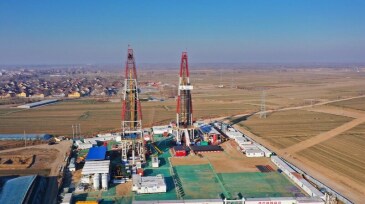
The company credited its theory of shale oil enrichment for the significant increase in the quantity of proven reserves at the field.
-
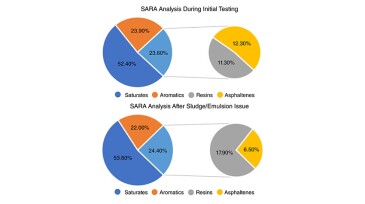
This work investigates the root cause of strong oil/water emulsion and if sludge formation is occurring within the reservoir using a robust integrated approach.
-
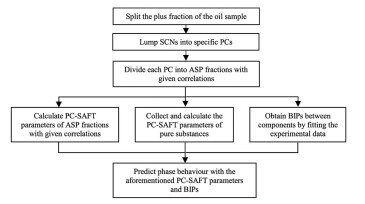
In this work, a perturbed-chain statistical associating fluid theory equation of state has been developed to characterize heavy-oil-associated systems containing polar components and nonpolar components with respect to phase behavior and physical properties.