Unconventional/complex reservoirs

The deal adds over 1,000 potential drilling locations and almost doubles oil production for Houston-based Magnolia.

Average output reached 13.6 million BOPD, extending a period of sustained growth that has kept the US at the forefront of global oil production.

The events will be co-located 3–5 May 2027 at Reliant Park in Houston, Texas.
-
 Service company Liberty Energy has announced the formation of Liberty Power Innovations which will specialize in compressed natural gas.
 -
The Denver-based company bulks up its Permian position with the purchase of three EnCap Investment portfolio companies.
-
This paper presents design considerations and field-trial applications for determining practical dimensions and limits for interdependencies associated with stage length, perforation clusters, and limited-entry pressures.
-
The authors of this paper develop a robust history-matched reservoir simulation model capable of predicting polymerflooding performance in the first such pilot to enhance heavy oil recovery on Alaska’s North Slope.
-
The authors of this paper define a work flow that constrains solutions that match models and field observations and obtains a more-representative model for forecasting and optimizing fracture behavior.
-
This paper presents the results of a comprehensive study performed to improve understanding of deep bottom-up water injection, which enabled optimizing the recovery of a heavy oil field in South Oman.
-
This paper presents an automated calibration process, probabilistic infill well ranking, and location optimization for a major heavy oil field in Colombia with original oil in place of more than 5 million STB.
-
The objective of this study is to conduct a comprehensive review of the latest technologies and work flows developed for heavy oil reservoir management.
-
The Calgary-based shale producer said the deal involves at least 600 new well locations that will keep it drilling for the next 20 years.
-
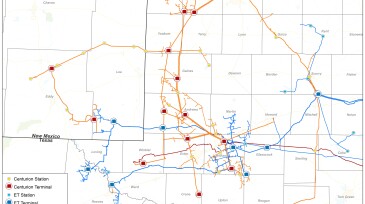
The acquisition will enable Energy Transfer to send more barrels of Permian crude to oil hub at Cushing, Oklahoma.