Water management
This paper presents an approach to the identification, selection, and implementation of initiatives for sustainable water management, withdrawal reduction, and water valorization.

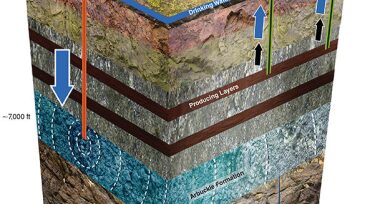
Disposal wells remain the lowest-cost solution for produced water, but concerns over seismicity and long-term sustainability are accelerating interest in alternatives.

This article addresses the challenges of managing water-soluble organics (WSOs) in offshore produced water. It provides a brief discussion of the chemistry, along with strategies and technologies that can be used to manage WSO levels in produced water, thus facilitating compliance with regulatory overboard water-quality guidelines.
-
 Tiny bubbles, called nanobubbles, are the focal point of a new innovation aimed at transforming produced water from a costly byproduct into a valuable asset.
 -
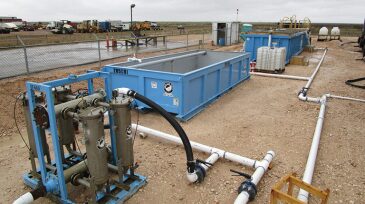
A new techhnology aimed at treating produced water at the wellsite to near-drinking-water quality.
-
Industry regulators in Oklahoma have rolled out broad new restrictions on more than 600 disposal wells as part of the largest action of its kind taken in response to earthquakes.
-
As the cost to source, transport, store, treat, and dispose of water remains relatively high, water management programs will become a greater priority in the coming year.
-
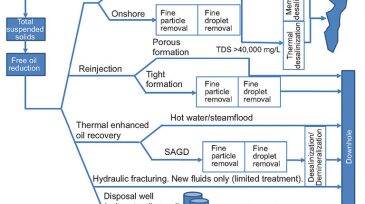
Produced water has become the largest byproduct in the oil and gas industry. Treatment and disposal or reuse of this byproduct requires a good understanding of conditions and options to devise the optimal strategy.
-
In the interest of conservation and sustainability, it is highly desirable to maximize any opportunity to reuse the produced water for subsequent fracturing treatments.
-
This paper reports the completion of a two-lateral well in the Williston basin where produced water (PW), filtered but otherwise untreated, was used throughout the slickwater and crosslinked components of approximately 60 hydraulic-fracturing stages.
-
This paper details the experience of using new stabilized crosslinked-fracturing-fluid systems in the Permian Basin using borated produced water.
-
This paper discusses aspects of water logistics necessary during the well-completion phase, fracture-treatment designs applied in Vaca Muerta, and laboratory studies performed on flowback and produced water to help evaluate the potential for water reuse.
-
A surge in earthquakes tightly clustered in southern Kansas that followed the large increase in produced water injections prompted the state to cut the daily limits on disposal wells in that area to see if that will help solve the problem.