


Geothermal energy is heating up at college campuses across the US—and not just in the classroom. The University of Rhode Island (URI), Central Washington University (CWU), and State University of New York (SUNY) at Oswego are the latest colleges tapping into geothermal energy to heat and cool buildings on their campuses.
In October, CWU in Ellensburg, Washington, announced its progress on a new North Academic Complex (NAC) to house social sciences, housing general classrooms, an auditorium, and dedicated spaces for the university’s law and justice program. The 108,000-ft2 building is expected to be fully operational in fall 2026, nearly 3 years after construction began in September 2023.

According to the university, the NAC will feature a geothermal heating and cooling system, leveraging the renewable heat from the Ellensburg Aquifer through a dedicated GeoEco Center, also constructed by the university.
The GeoEco Center will include an open-loop ground source heat pump system and is expected to be completed in early 2026. The NAC and GeoEco Center, which will replace two energy-inefficient academic buildings constructed in the 1970s, will lead to a reduction of 33,000 metric tons of carbon emissions over the course of 50 years.
In September 2024, the university reported that the GeoEco Center’s equipment for the geothermal system will include an injection well, extraction well, a six-pipe heat pump, and a groundwater heat exchanger. The groundwater, which serves only as an energy exchanger, will be extracted from the Ellensburg Aquifer (800-1,000 ft below the Earth's surface), and the injection well will return the groundwater to the aquifer.

“Once operational, this system will connect to 500,000 ft2 of academic space across campus, reinforcing our commitment to sustainable building practices,” said Delano Palmer, CWU’s director of capital planning and projects.
Like CWU, URI will use geothermal energy to heat and cool its new Ocean Frontiers Building on the Narragansett Bay Campus. Construction of the new building is part of the university’s revitalization project which will replace the 55-year-old Horn Laboratory with modern environmentally controlled labs.
“Geothermal systems reduce reliance on fossil fuels, lower greenhouse gas emissions, stimulate the green economy, and provide long-term savings related to operating and life cycle replacement costs,” said Seth Pilotte, construction projects manager at the Narragansett Bay Campus.
According to the university, the Ocean Frontiers Building is expected to reduce energy use by 30–60% for heating and up to 50% for cooling.
Discussions on the project first began in March 2024. A year later, an 850-ft deep geothermal test well was drilled to gather data confirming the cost effectiveness and overall feasibility of using geothermal energy on campus.
PPL Corp. provided the university with a $100,000 grant to complete the planning and testing. Gaining access to the testing site revealed itself to be a challenge.
“Access to the site was difficult due to the small width of the roadways and steep elevation changes at the east side of the quad,” said Pilotte.
Once access was granted, a specialized drilling rig cored through 10 ft of surface clay and 800 ft of bedrock using the mud-to-air method.
“The results of the investigation were that the geology possesses excellent thermal conductivity characteristics and good drilling conditions, yielding a high rate of production, making it feasible to design and implement a geothermal system at this location,” said Pilotte.

Anticipated to open in 2028, the Ocean Frontiers Building will house URI’s Graduate School of Oceanography.
Staying in the northeast, SUNY Oswego opened the doors to its geothermally heated and cooled Hewitt Hall in fall 2025. The opening comes nearly 4 years after the project’s groundbreaking in 2021.
Funded by $80 million from the SUNY Construction Fund, the building is home to the university’s College of Communication, Media, and the Arts.
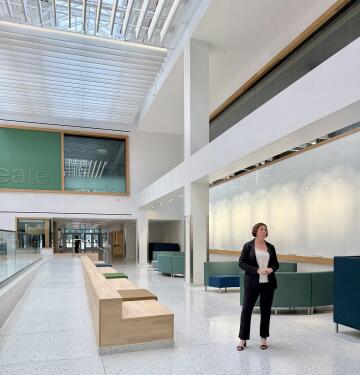
“To date, SUNY Oswego has constructed two geothermal fields serving the Shineman Center and Hewitt Hall, representing a $5-million investment. An additional $20 million will expand the system to the remaining Hewitt Quad buildings,” said Mitch Fields, associate vice president for facilities services.
The two geothermal fields were drilled with 90 6-in. boreholes, each 500-ft deep, requiring 8.5 miles of drilling to install 18.8 miles of piping.
Throughout the next decade, SUNY Oswego will renovate key academic buildings including Mahar Hall, Culkin Hall, Lanigan Lecture Center, and Penfield Library to use geothermal energy.
“This approach enables centralized heat exchange with the Earth, allowing different buildings to independently draw heat or reject heat as needed,” Fields said. “The network improves overall efficiency through load balancing, reduces infrastructure costs and supports scalable, campuswide sustainability goals.”

The opening of Hewitt Hall comes nearly a decade after the university committed to eliminating campus fossil fuel consumption and achieving net carbon neutrality.
“Perhaps most importantly, SUNY Oswego is preparing the next generation of sustainability leaders by offering students meaningful, hands-on learning opportunities in renewable energy, environmental science, and climate-conscious design,” Fields said. “In doing so, the university is not just responding to the climate crisis—it’s shaping the solution.”
