

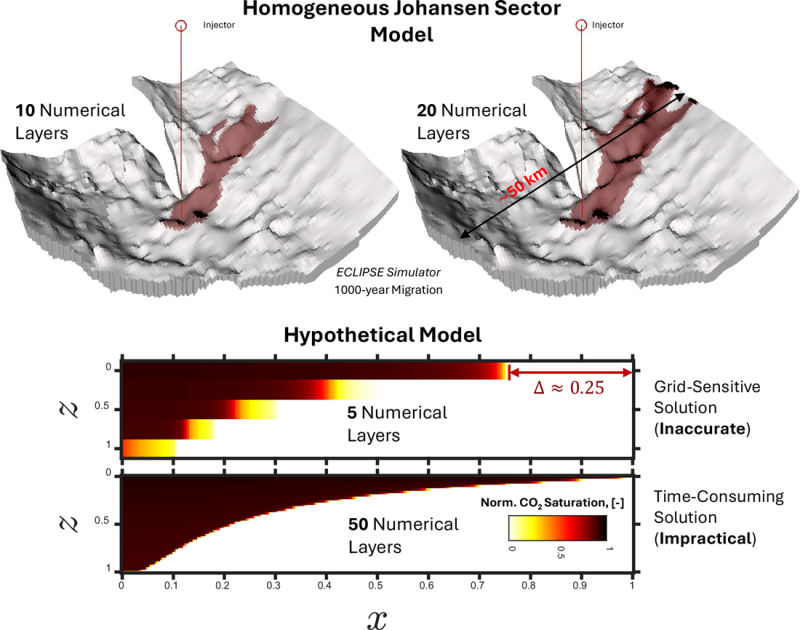
Vertical equilibrium (VE) modeling has become a standard reduced-dimensional approach for large-scale subsurface storage applications. This study revisits the topic and develops a unified framework to assess the conditions under which it remains accurate using inspectional analysis and numerical simulation.
Within this framework, VE modeling is formulated as the result of vertical integration combined with the parallel-flow assumption, so that hydrostaticity emerges as a consequence rather than being imposed a priori. A compact representation of the depth-averaged flow equations is then introduced through a convex combination, parameterized by a phase distribution parameter, the values of which are inferred from limiting regimes, and estimated numerically.
The proposed formulation is directly compatible with existing reservoir simulators and clarifies the hierarchy of the approach and its applicability across flow regimes beyond segregated flow, to which it is often restricted.
For gravity-segregated flows, capillarity plays an important role in long-term migration, with an effective Bond number proportional to current thickness governing its influence on plume shape and migration velocity. Under such conditions, the reliability of VE modeling depends on the instantaneity of gravity-capillarity equilibrium, the timescale of which is examined using simplified scaling and simulation models and found to be generally reasonable for long-term migration studies.
The validity of the sharp-interface assumption is also assessed through comparison with finite capillary transition zone models. Wherever possible, numerical results are compared with analytical solutions. Closed-form expressions are reported for depth-averaged flow functions corresponding to the fine-scale Brooks-Corey-Burdine model under equilibrium, for which the SI flow functions arise as the leading-order limit.
Overall, the findings are summarized through simple expressions, dimensionless groups, and regime maps that provide practical guidance for implementation. An application case for a real CO2 injection site is briefly presented.
This abstract is taken from paper SPE 229169 by H. Alamara and I. Bogdanov, Computational Hydrocarbon Laboratory for Optimized Energy Efficiency (CHLOE), and C. Blondeau, TotalEnergies CSTJF.The paper has been peer reviewed and is available as Open Access in SPE Journal on OnePetro.