

simulation
-
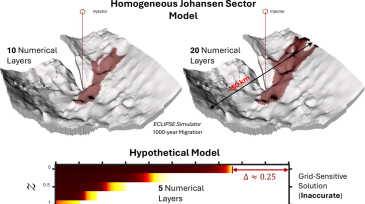
 A new framework combines analytical and numerical insights, extending vertical equilibrium modeling and guiding reservoir-scale implementation, providing reservoir engineers with practical guidance for assessing accuracy across flow regimes and long-term carbon-dioxide migration.
 -
This research focuses on combining physics-based expert rules with machine learning to improve the detection of failure-related events in electrical submersible pumps.
-
This paper presents the deployment of an artificial intelligence-enabled autonomous gas lift optimization system, integrating real-time centralized advanced process control with cloud-based analytics to enhance artificial gas lift performance in producer wells.
-
By integrating reservoir simulation, probabilistic seismic hazard and risk assessment, and machine learning, this study provides a practical framework for translating complex geoscientific research into evidence-based policy and field operations, achieving measurable reductions in seismic risk indicators in the Groningen gas field.
-
This article from the SPE Research and Development Technical Section offers new insights to how the upstream industry can benefit from the emergence of quantum computing.
-
The DOE-backed EGS-Twin project aims to simulate geothermal production systems, helping operators better predict performance and maximize output.
-
Modeling solubility trapping at reservoir scale remains a key challenge for carbon storage projects. This study introduces a novel sub-grid convective mixing model, implemented in the Open Porous Media Flow simulator and applied to the SPE11 benchmark, that enables accurate prediction of carbon dioxide dissolution trapping in geological storage using computationally e…
-
This article from the SPE Integrated Reservoir Management Technical Section (IRMTS) addresses decisions that look stronger than they are and take longer to implement than the reservoir can afford.
-
This paper presents a competency-centered, data-driven approach implemented to strengthen control-room emergency-response capability through a cloud-hosted, scenario-based virtual plant simulator.
-
This work evaluates CO2-based fracturing as a sustainable development approach for shale gas reservoirs in the Burgos Basin of Mexico.







Page 1 of 4