Chevron, Eni, and QatarEnergy, together with a consortium of Repsol, TPAO, and Hungary’s Mol Nyrt, have emerged as winners in Libya’s first exploration licensing round in nearly two decades as the war-torn country—gifted with Africa’s largest oil reserves—prepares to boost gas exports to Europe by early 2030.
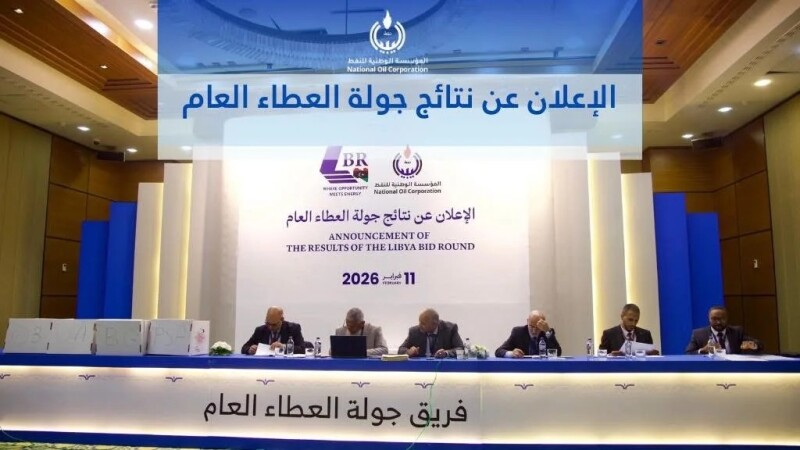
Libya’s state-owned National Oil Corporation (NOC) announced the awards, the first since 2007, on 11 February in a ceremony live-streamed from Tripoli. Only five of the 20 exploration blocks on offer received valid bids, and officials say they will retender amended offers in a follow-up bidding round.
“This licensing round represents Libya’s most meaningful re-engagement with international upstream investment in nearly two decades,” said Ross Cassidy, vice president, Middle East and North Africa research, at Welligence Energy Analytics. “This is one of the biggest oil and gas events to watch this year.”
Earlier, NOC’s chairman, Masoud Suleman, announced at a conference in Qatar on 3 February that Libya seeks to raise its natural gas production over the next 5 years to around 1 Bscf/D from conventional and shale fields to supply Europe via the Greenstream pipeline.
In his remarks, Suleman also said that upcoming bid rounds would include unconventional resources or marginal fields.
Focus on the Sirte Basin
After the overthrow of Moammar Gadhafi in 2011 forced Chevron to exit Libya, the US major is now set to return to explore the S4 block in the Sirte Basin, Libya’s most prolific onshore area.
Also in the Sirte Basin, but at 2000 m water depth, Block O1 went to a consortium of Eni (60% operator interest) and QatarEnergy (40% participating interest). Eni noted in a news release that the consortium will conduct 2D/3D seismic acquisition and drilling activities over the first 5-year exploration period.
Another consortium of Spain’s Repsol (operator, 40%), TPAO (40%) and Hungary’s Mol Nyrt—a part of MOL Group—(20%) scooped the license for Offshore Block 07, also in Sirte.
The 20 blocks put up for auction last year hold an estimated 10 billion bbl of available resources with an estimated 18 billion bbl yet to be discovered, according to NOC, which offered new production-sharing agreements with simplified cost recovery and clearer profit sharing.
Investment Begins To Build
In January, TotalEnergies and ConocoPhillips signed deals to invest up to $20 billion over 25 years to more than double production capacity of their Waha Oil venture as NOC seeks to boost the country’s crude output to 2 million B/D by 2030 from 1.4 million B/D currently.
According to Welligence, Libya stabilized its crude production at 1.4 million B/D in 2025, the highest level in over a decade. While oil output has recovered, the country’s natural gas sector remains underdeveloped, despite large resource potential, flaring, and proximity to European markets.
NOC and OPEC estimate Libya’s gas reserves at up to 55 Tcf. That though could rise to 80 Tcf if undeveloped unconventional resources are considered, according to NOC. The country’s major gas fields are in the Sirte Basin onshore and offshore, the offshore Bahr Essalam fields, and the onshore Wafa field.