

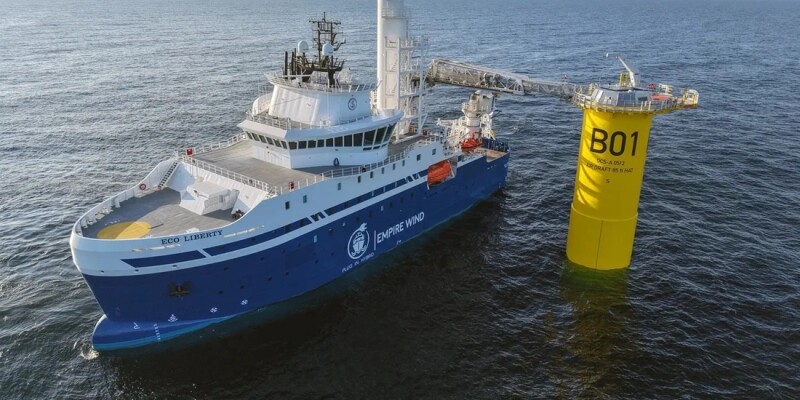
The US District Court for the District of Columbia granted Empire Offshore Wind a preliminary injunction that allows construction activities to resume on the Empire Wind project.
The underlying lawsuit challenging the US Department of the Interior’s (DOI) 22 December 2025 suspension order will continue to proceed.
Equinor sad Empire Wind now will focus on safely restarting construction activities that were halted during the suspension period. In addition, the project will continue to engage with the US government to ensure the safe, secure, and responsible execution of its operations, the company said.
Empire Wind is being developed under contract with the New York State Energy Research and Development Authority to deliver a new near-term source of electricity for New York and bolster grid reliability at a time of rapidly growing demand. Once completed, the project is expected to provide enough power to electrify approximately 500,000 homes in New York.
Construction on the on-again/off-again project also had been halted in April 2025 by a stop-work order issued by the US Bureau of Ocean Energy Management. That order was lifted in May 2025.
The most recent stoppage was initiated by the DOI, which cited national security risks.
“Today’s action addresses emerging national security risks, including the rapid evolution of the relevant adversary technologies, and the vulnerabilities created by large-scale offshore wind projects with proximity near our east coast population centers,” Secretary of the Interior Doug Burgum said in a DOI news release in December 2025.
The national security risks cited by Burgum involved radar interference from spinning turbine blades, which results in obscured targets offshore, according to the DOI.
“Unclassified reports from the US government have long found that the movement of massive turbine blades and the highly reflective towers create radar interference called ‘clutter,’” the news release said. “The clutter caused by offshore wind projects obscures legitimate moving targets and generates false targets in the vicinity of the wind projects.”