

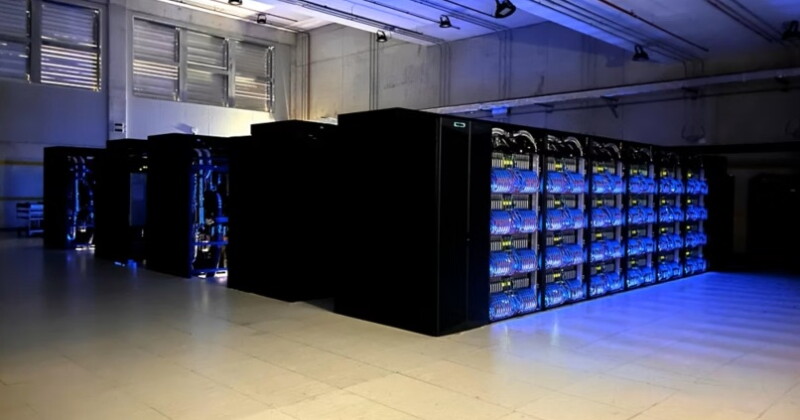
Eni announced the launch of its new supercomputing system, HPC7, which, with a capacity of over 861 petaflops, ranks sixth overall in the new TOP500 global ranking, confirming its position as the world’s most powerful high-performance computer (HPC) for industrial use. HPC7 surpasses HPC6, launched in November 2024, which, in turn, has confirmed its position within the TOP10, ranking eighth in the TOP500 list.
The combination of the HPC6 and HPC7 computing systems exceeds the exascale threshold. Together, HPC6 and HPC7 can deliver over 1 exaflops (1 exaflops = 1,000 petaflops), equivalent to more than 1 billion billion complex mathematical operations per second.
Eni said advanced computing and HPC systems are central to its mission, enabling the integration and enhancement of expertise and applications across the entire value chain, from subsurface understanding to the optimization of industrial plant operations, as well as improving the accuracy of geological and fluid dynamics studies for CO2 storage and the development of advanced energy technologies.
Supercomputing also contributes to accelerating the evolution of key innovation drivers, supporting the efficiency of emerging value chains, such as biofuels, and the simulation of complex phenomena, including plasma behavior in magnetic confinement fusion.
Eni added that high-performance computing is also an enabler for the internal development of artificial intelligence.
The new HPC system builds on HPC6’s 477 petaflops sustained with HPC7’s 571 petaflops, corresponding to peak performance values of 606 petaflops for the former and 861 petaflops for the latter.
HPC7 is based on an architecture that uses the same technology that underpins the most powerful systems available in Europe and worldwide, combining central processing units and graphics processing units (GPUs) in a hybrid configuration, with over 3,400 computing nodes and nearly 14,000 GPUs, to maximize computational performance and energy efficiency.
The combined computing power of HPC6 and HPC7 reaches 1048 petaflops sustained and 1467 petaflops peak.
With a power consumption value of 65.426 gigaflops/W, HPC7 also achieved a high position in the dedicated Green500 ranking—which measures system efficiency—placing 11th worldwide and ranking first among peer systems in its category.
“The transition toward energy from both traditional and renewable sources that is increasingly secure, accessible, and clean cannot take place without a profound technological evolution,” said Eni CEO Claudio Descalzi. “The adoption of supercomputing and predictive technologies across all activities is essential for developing new energy solutions, reducing emissions, maximizing efficiency in exploration and production, and generating value. In this context, the rapid development and commissioning of HPC7—completed in an even shorter timeframe than HPC6, which was already a benchmark—represents a concrete example of our execution capabilities, the result of the expertise, commitment, and quality of our operational teams. This robust digital ecosystem, developed through talent, collaboration, and internal research, not only accelerates our path toward net zero but also strengthens our strategic positioning and competitive advantage in the market.”
Both supercomputers are in a dedicated area of Eni’s Green Data Center, benefiting from an infrastructure designed to combine operational efficiency with environmental sustainability. The Green Data Center, already among the European leaders in energy efficiency and emissions reduction, uses direct liquid cooling technology capable of dissipating 96% of the heat generated.