Testing page for app
-
 The paper provides insights on diffusion in organic matter to correct a primary source of underestimation of gas production in shale-gas models.
 -
This paper presents a mathematical analysis of how incorrect estimates of initial reservoir pressure may affect rate-transient analysis in ultralow-permeability reservoirs.
-
SPE Distinguished Member and a founder of the SPE’s first section in Moscow, died 13 March. He was 76.
-
As we continue to advance the capability in the laboratory environment to test downhole condition measurements experimentally, the tools we are using appear to be bridging the subsurface characterization with the production results. Continued focus on unconventionals is complemented with a renewed focus on conventional research as well.
-
The key element of hydraulic-fracture modeling is the prediction of the generated fracture geometries. Research conducted over the years has trickled down predictive software. Nevertheless, the ability to design optimal fracture treatments is hampered, as we cannot “see” the subsurface.
-
In this work, novel physics-based models and machine-learning models are presented and compared for estimating permanent-downhole-gauge measurements.
-
The rural Weld County projects total almost 100 new wells in the Wattenberg.
-
The paper describes a method to match reaction kinetics from coreflooding experiments.
-
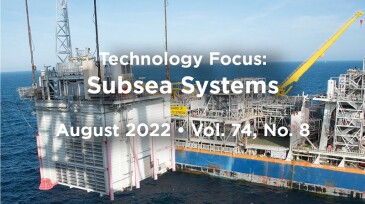
In current offshore operations—with an emphasis on environmental, social, and governance performance—subsea has an increasingly important role to play. Subsea tiebacks in particular offer opportunities to increase asset productivity while minimizing environmental impact on an incremental production-per-barrel basis.
-
Drillers are working to find ways to break some bad data habits. Those problems can range from the use of multiple formulas to calculate mechanical specific energy to timekeeping systems where the clocks and the time records are often off.