Testing page for app
-
 One of the more technologically challenging production-chemistry applications in deep water is the control of gas hydrates. Deepwater subsea flowlines offer an almost perfect hydrate-formation environment, and control measures must be taken.
-
The complete paper presents and discusses the authors’ technology-development program regarding very-long oil-tieback architectures (50–100 km) and enabling technologies.
-
As part of an effort to evaluate existing riser systems, an operator launched an inspection and testing program to investigate risers retrieved following well abandonment after a service life of nearly 10 years in the Gulf of Mexico.
-
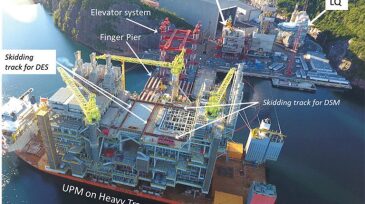
The Hebron platform was successfully installed on the Grand Banks offshore Newfoundland and Labrador in June 2017. It consists of a single-shaft concrete gravity-based structure (GBS) supporting an integrated drilling and production topsides.
-
A common hydrate-management strategy involves the use of large volumes of thermodynamic inhibitors (THIs) to operate outside the hydrate-stability region.
-
The complete paper investigates gas-hydrate inhibition in a simulated offshore environment using a plant extract (PE) as a local inhibitor.
-
This paper summarizes historical advancements in low-dosage hydrate inhibitors (LDHIs) over the past 2 decades, discusses their advantages and limitations, and their selection criteria.
-
When Apache rolled out a digital system delivering real-time drilling data and advice, the reactions from workers were strong, and conflicting.
-
Occidental drillers and engineers figured out that it is faster and cheaper to reduce the weight on bit (WOB) than speeding ahead, which increased the risk of a breakdown and time lost for repairs.
-
Corva’s challenge is to change the behavior of drillers who work for somebody else. The fast-growing company has no shortage of users.