Testing page for app
-
 The complete paper describes a work flow in which wells and production networks in the Cheleken Block offshore Turkmenistan are automatically modeled daily with steady-state and transient tools and ultimately analyzed by the Cheleken Block Central Data Gathering System.
 -
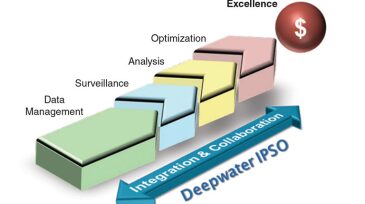
The complete paper describes some of the technical challenges faced in deepwater operations and the methodology adopted for implementing an integrated production surveillance and optimization (IPSO) system to mitigate the risks.
-
In the onshore world, one of the big advances for addressing increased sampling requirements has been to go to 24-hour shooting with continuous recording of simultaneously sweeping vibrators. This has been enabled by innovations in both acquisition and processing.
-
The feasibility test conducted offshore Abu Dhabi demonstrated the successful and safe deployment, seismic-data acquisition, and retrieval capabilities of the AMV and 3D sensor array.
-
Integrated surveillance is critical for understanding reservoir dynamics and improving field management. A key component of the surveillance is areal monitoring of subsurface changes by use of time-lapse geophysical surveys such as 4D seismic.
-
The complete paper proposes an azimuthal plane-wave-destruction (AzPWD) seismic-diffraction-imaging work flow to efficiently emphasize small-scale features associated with subsurface discontinuities such as faults, channel edges, and fracture swarms.
-
Despite the recent downturn, a significant number of pilot- or demonstration-scale applications of existing technologies to develop new heavy-oil fields or new technologies to develop existing fields have been reported over the past year.
-
This paper presents the planning and execution of a matrix-stimulation pilot project in the heavy-oil Chichimene Field in Colombia.
-
Cyclic steam stimulation (CSS) is one of the principal enhanced-oil-recovery methods for heavy oil. CSS was performed in some of the wells of a heavy-oil field in Kuwait. Multiple cycles were applied in these wells. However, the total water produced in each cycle was much less than expected.
-
The appreciation of empirical realities permits the improvement of commercial depletion planning and enables a greater number of projects. This paper reviews the evidence for and against three doctrines in current use to develop depletion plans.