Hydraulic Fracturing Content Feed
-
 For those in shale exploration, “fracability” is a real word, a critical property, and a point of contention.
 -
With inconsistent inlet water quality being the rule rather than the exception, sizing and operational considerations of the treatment system components must vary accordingly to make the most economic sense.
-
While shale unproved technically recoverable resources have been identified around the world, development has been limited to North America.
-
Some operators are returning to their North American mature unconventional shale wells to refracture, or restimulate, the rock to accelerate production and enhance ultimate recoveries.
-
At the 2014 SPE Hydraulic Fracturing Technology Conference in February, former Texas A&M Department of Petroleum Engineering head Stephen A. Holditch received a well-deserved lifetime achievement recognition, the Legends of Hydraulic Fracturing Award.
-
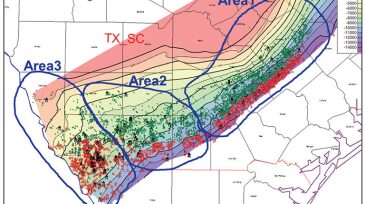
The purpose of this paper is to apply multivariate statistical modeling in conjunction with geographic-information-systems (GIS) pattern-recognition work to the Eagle Ford.
-
Production from the Bakken and Three Forks formations within the Williston basin is continuing to climb as a result of applied horizontal drilling and hydraulic fracturing.
-
Using large-scale hydraulic-fracturing experiments on tight shale outcrops, three dominant regions controlling stage production were identified.
-
An analysis of thousands of fracturing treatments in major plays in the United States provides insights into how fracture designs have changed over time.
-
Fiber optic pressure and temperature (P/T) sensing technology for multizone fracturing and production monitoring is enabled by a new feed-through (FT) technology that integrates the optical fiber within the multiple elastomer elements of a compact, swellable openhole packer system.