

JPT August 2026 Issue
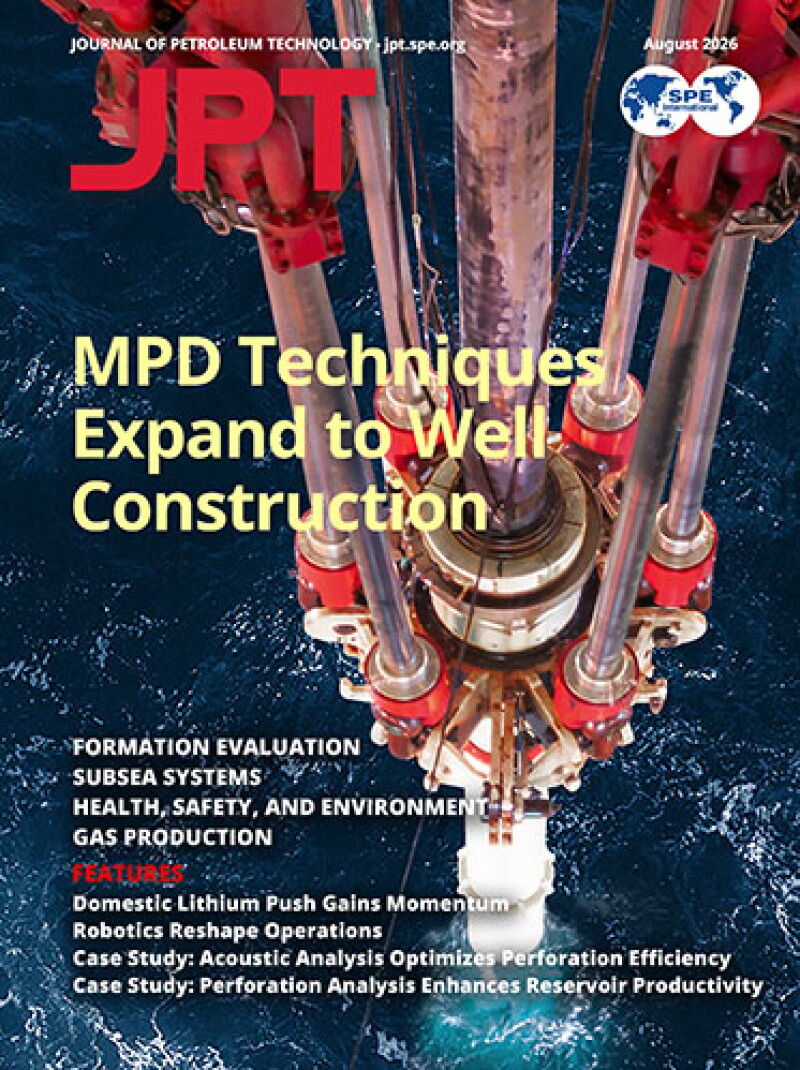
On the Cover
Weatherford MPD equipment being deployed from a deepwater drilling rig for pressure management during offshore operations. Source: Weatherford.
Monthly Features
-
 As several commercial-scale projects are gearing up in the US, developers expect the next few years to reveal whether lithium extraction from brines can become a big business.
 -
 As managed pressure drilling gains traction, its principles are influencing a wider range of well-construction activities.
 -
 From AI-enabled walking rigs to subsea drones and autonomous inspection robots, robotics is rapidly moving from pilot projects to field deployment. The technology promises not only greater efficiency but also a fundamental shift in how the industry approaches safety and asset management.
 -
 This guest editorial examines how the most commonly used and cited methane emissions metric can create a misleading picture of upstream gas-handling performance for both the public and industry professionals.
-
 In her final column as SPE President, Jennifer Miskimins reflects on a year of service, celebrates the people behind SPE’s success, shares updates on the Society’s future, and encourages members to remain engaged in advancing the profession and the energy industry.
-
 This case study from Malaysia’s Petronas outlines a comprehensive review of perforation-charge testing across various tubular and reservoir conditions to help improve production from complex downhole scenarios.
-
 This case study presents the first field deployment of acoustic fracturing analysis to evaluate perforation efficiency and implement real-time interventions during pressure pumping.
-
 A handful of operators have cut costs, project timelines, and emissions by redeploying offshore infrastructure, but there are limited opportunities to replicate these success stories.
-
 Equinor, ADNOC, Eni, Santos, Saipem, and Halliburton lead this week’s offshore energy headlines, with a new Barents Sea discovery, a $6.2 billion UAE gas project FID, and major contract awards across Côte d’Ivoire, Iraq, Libya, and Romania. Key updates also include progress at Santos’ Barossa and Pikka developments and new North Sea drilling commitments from Equinor a…
-
 This section lists with regret SPE members who recently passed away.
-
 SPE technical papers synopsized in each monthly issue of JPT are available for download for SPE members for 2 months.
Formation Evaluation
-
 Carbon capture, use, and storage places injectivity at the center of formation evaluation, elevating it from a secondary operational concern to a primary determinant of storage feasibility and performance.
Subsea Systems
-
 The selected papers for this year’s feature collectively illustrate a clear industry transition toward subsea-centric architectures that decouple production performance from topside constraints, combining processing, boosting, and simplified system designs adapted to specific field conditions.
Health, Safety, and Environment
-
 Crisis and continuity management is fundamentally about preparedness. Its purpose is to ensure that an organization clearly understands what actions to take during an incident rather than having to define roles and processes under pressure.
Natural Gas Production
-
 Across gas assets, operators are under increasing pressure to improve recovery, enhance production efficiency, and maximize the value of existing infrastructure under tighter technical and economic constraints. In shale developments, this translates to optimizing stage and cluster design and, more importantly, leveraging data-driven approaches to better understand sti…