

JPT February 2026 Issue
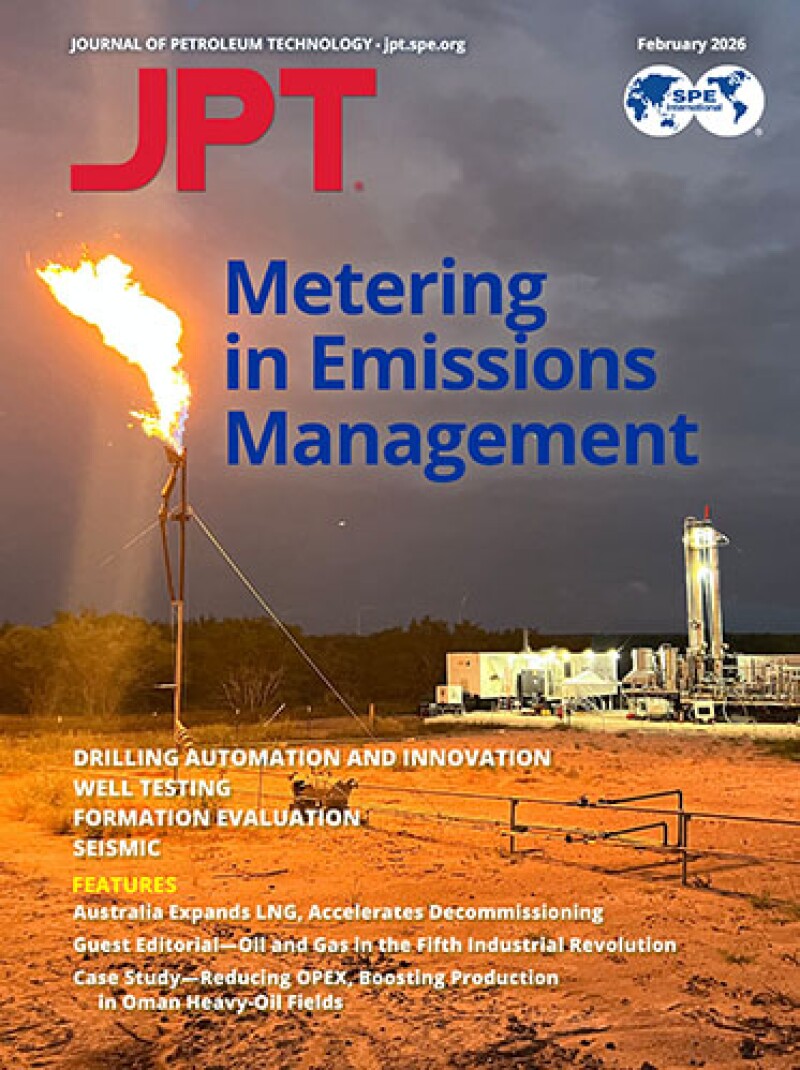
On the Cover
The F2X unit at the South Texas pilot. Source: Macaw Energies.
Monthly Features
-
 Monitoring on the ground is helping the industry shift from best estimates to hard data so it can bring the true emissions profile into focus.
 -
 Despite a 2.8% drop in liquefied natural gas exports in 2025 because of lost market share in China, Australia anticipates a 2026 rebound as new North West Shelf capacity comes online. Meanwhile, East Coast operators brace for a tsunami of wells entering the decommissioning pipeline and potential energy shortfalls necessitating LNG imports.
 -
 To overcome operational constraints tied to ball-and-seat valves, an operator tested a spring-loaded alternative downhole.
 -
 This guest editorial explores the rise of agentic AI and its potential effect on oil and gas professionals.
-
 From JPT to SPE Journal, OnePetro to technical guidance documents, SPE’s publishing portfolio is broader and more dynamic than many members may realize. In this column, I unpack the Society’s current publication options, explore how AI and open access are reshaping scholarly publishing, and share what SPE is doing to strengthen paper quality, transparency, and impact …
-
 Ongoing seismicity concerns and orphan well risks are pushing operators and regulators to explore alternatives for managing produced water.
E&P Notes
-
 Updates about global exploration and production activities and developments.
SPE Technical Paper Downloads
-
 SPE technical papers synopsized in each monthly issue of JPT are available for download for SPE members for 2 months.
Drilling Automation and Innovation
-
 When it comes to drilling automation, deciding where your technology should be deployed is a critical factor in overall solution design. Similar to other industries, there is an eternal debate on the merits of cloud vs. edge systems.
Well Testing
-
 This month’s papers highlight new combinations of technologies, along with workflows automated in innovative ways, deployed to ensure precise measurement, accurate forecasting, and environmentally conscious operations.
Formation Evaluation
-
 This Technology Focus highlights three developments in formation evaluation related to measurement, interpretation, and integration.
Seismic
-
 Seismic technology continues to progress at a remarkable pace, driven by advances in artificial intelligence, imaging, interpretation, monitoring, and the expansion of seismic applications across the wider energy sector. One clear trend is the industry’s move toward high-frequency and ultrahigh-resolution seismic, which has pushed the limits of what can be resolved in…