

JPT September 2026 Issue
On the Cover
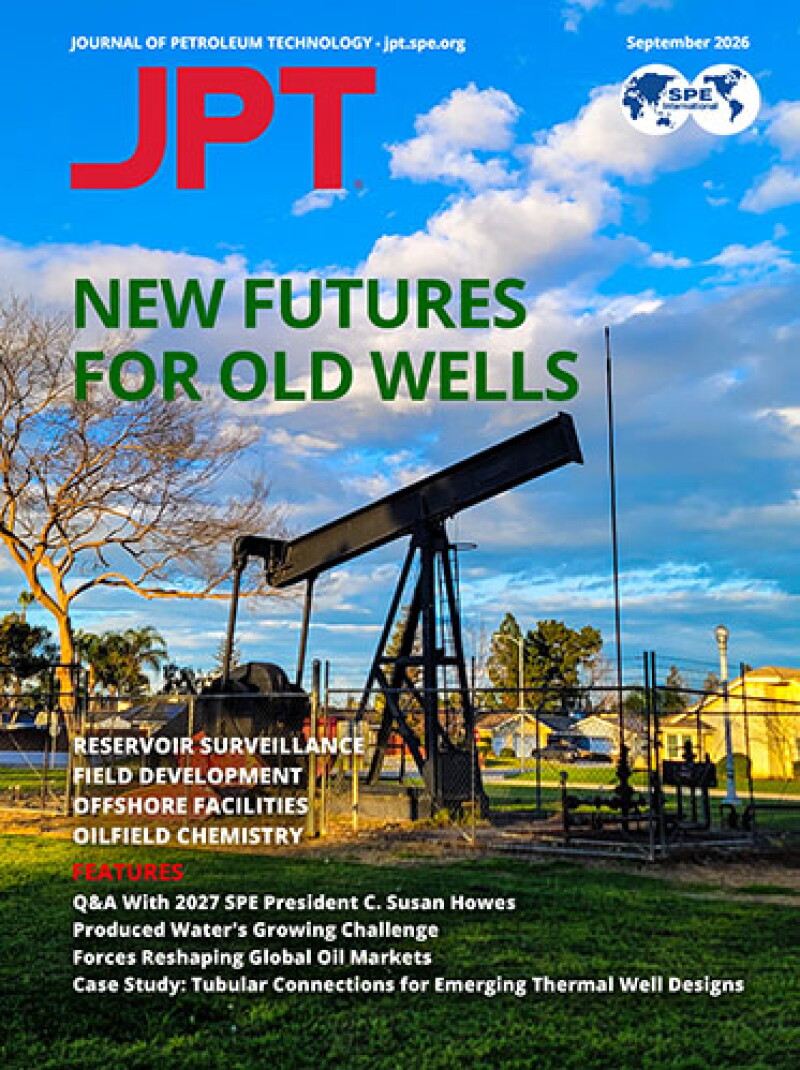
An abandoned oil well sits idle in a US neighborhood. The US is home to approximately 3.4 million old, unused wells. Source: Anthony K. Mord/Getty Images.
Monthly Features
-
 Oil prices are high, but spending has not caught up—yet. Meanwhile, exploration strategies are changing around the world toward a lower-risk model, and the frenzied pace of US M&A has very much cooled off.
 -
 Disposal wells remain the lowest-cost solution for produced water, but concerns over seismicity and long-term sustainability are accelerating interest in alternatives.
 -
 With millions of wells having been drilled in the US since the beginning of the oil age, the land is pocked with old, unused wellbores. For most, repurposing is a pipe dream. Plugging is the best option.
 -
 This case study outlines a full-scale testing program focused on the behavior of thermal casing connections subjected to severe bending and low-cycle fatigue loading.
-
 2027 SPE President C. Susan Howes discusses her vision for SPE, highlighting the Society’s role in professional growth and the development of future energy leaders. In this JPT interview, she explains why investing in people is key to the future of the energy industry.
-
 This guest editorial addresses the many capacities in which oil and gas technical professionals can play a role advancing the energy technologies of tomorrow.
-
 The world produces vast volumes of carbon dioxide, and CO₂-EOR is one of the best-established techniques for increasing oil production. Despite this, its use remains limited because of economic, logistical, and operational challenges.
-
 This energy roundup highlights major global developments, including Western Australia’s approval of Woodside’s Browse gas project, TotalEnergies’ FID for Cyprus’ first gas development, and new oil and gas discoveries offshore Colombia, Namibia, and Angola. Read the latest updates on LNG projects, exploration successes, seismic surveys, and strategic upstream investmen…
-
 Zaki Bassiouni, the former dean of LSU's College of Engineering, passed 8 July.
-
 This section lists with regret SPE members who recently passed away.
-
 SPE technical papers synopsized in each monthly issue of JPT are available for download for SPE members for 2 months.
Reservoir Surveillance
-
 The industry is no longer short of measurements; the real challenge is converting them into timely reservoir decisions that protect value. That challenge is becoming more urgent as the industry depends increasingly on mature fields and existing infrastructure. The selected papers show how this need is being addressed across different producing regions.
Field Development
-
 The papers selected for this year’s feature collectively highlight the ongoing transformation of field-development planning across the oil and gas industry. A common theme among these papers is the integration of subsurface, drilling, facilities, and operational workflows into unified development frameworks.
Offshore Facilities
-
 Within the oil and gas industry, the arena of offshore facilities is subject to the same emphases and initiatives as its terrestrial counterpart. This year’s selections reflect an emphasis on emissions reduction and facilities repurposing for carbon capture, use, and storage projects as well as advances in automation and unattended operations.
Oilfield Chemistry
-
 Injection of CO₂ into depleted gas reservoirs, and even more so for saline aquifers, initiates a series of interconnected physical and geochemical phenomena. The geochemical process within silicate and carbonate reservoirs offers the potential to enhance storage by creating secure CO₂ reactions with rock/brine/additives.