

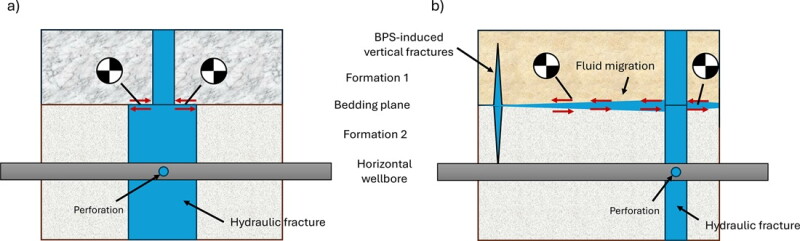
This study presents the first documented field evidence of large-scale bedding plane slippage (BPS) induced by hydraulic fracturing operations in the Eagle Ford and Austin Chalk formations of southwest Texas.
Using an integrated geophysical monitoring approach—including low-frequency distributed acoustic sensing (LFDAS), surface-based microseismic monitoring, and time-lapse vertical seismic profiling (VSP)—the authors investigated the complex fracture dynamics and fluid migration pathways associated with stimulation.
LFDAS measurements revealed migrating dipole strain signals consistent with shear-mode fractures propagating parallel to the monitor well, which was interpreted as BPS events. Microseismic moment tensor analyses supported this interpretation, identifying horizontal-slip events concentrated near the treatment and monitor wells.
Additionally, time-lapse VSP data indicated the reactivation of pre-existing vertical fractures, correlating with BPS signals and suggesting fluid communication between bedding planes and natural fracture networks.
Geomechanical modeling using the 3D displacement discontinuity method (3D DDM) further validated that shear fractures along bedding planes can reproduce the observed LFDAS responses.
These interactions between bedding planes and vertical fractures contribute to a more complex fracture network than anticipated, potentially enhancing reservoir connectivity and production performance. However, the findings also highlight potential inefficiencies and risks, including stage isolation failure due to conductive bedding planes and casing deformation due to shear displacement.
This study underscores the need for adaptive completion design and well placement that account for natural fracture systems and bedding plane dynamics to optimize hydraulic fracturing efficiency and economic returns in similar unconventional reservoirs.
This abstract is taken from paper SPE 230601 by G. Jin, Colorado School of Mines; J. Mjehovich, IFDATA LLC; J. Correa, Lawrence Berkeley National Laboratory; X. Zhu, Rice University; S. Glubokovskikh and A. Nayak, Lawrence Berkeley National Laboratory; K. Wu, Texas A&M University; W. Wang, IFDATA LLC; B. Freifeld, Class VI Solutions, Inc.; and J. Ajo-Franklin, Rice University.The paper has been peer reviewed and is available as Open Access in SPE Journal on OnePetro.