

Monthly Features
-
 Oil prices are high, but spending has not caught up—yet. Meanwhile, exploration strategies are changing around the world toward a lower-risk model, and the frenzied pace of US M&A has very much cooled off.
 -
 This case study outlines a full-scale testing program focused on the behavior of thermal casing connections subjected to severe bending and low-cycle fatigue loading.
 -
 Disposal wells remain the lowest-cost solution for produced water, but concerns over seismicity and long-term sustainability are accelerating interest in alternatives.
 -
 With millions of wells having been drilled in the US since the beginning of the oil age, the land is pocked with old, unused wellbores. For most, repurposing is a pipe dream. Plugging is the best option.
 -
 This case study from Malaysia’s Petronas outlines a comprehensive review of perforation-charge testing across various tubular and reservoir conditions to help improve production from complex downhole scenarios.
 -
 This case study presents the first field deployment of acoustic fracturing analysis to evaluate perforation efficiency and implement real-time interventions during pressure pumping.
-
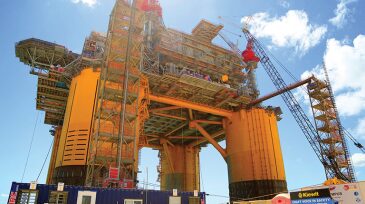
 The new Olympus tension leg platform (TLP) is the largest in the US Gulf of Mexico, with more than twice the displacement of the neighboring Mars TLP. It marks a leap forward in safety, improved operation time, and increased production capacity.
 -
Twenty-eight peer-selected lecturers from various disciplines and professions share emerging trends, challenges, and technologies.
-
Saudi Aramco's new R&D centers in the US will help bridge international scientific expertise and technology.
-
Robert Estes, manager of emerging technology at Baker Hughes, notes that commonly in electronic parts, the failure of semiconductors, microprocessors, memory, and dense chips at high temperature is not the silicon.
-
While there are rechargeable batteries rated to 125ºC, many service companies prefer not to use them because a rating of 150ºC is preferable. The industry typically uses one-time-use lithium primary batteries.
-
Another technology under development that takes raw natural gas from the wellhead and converts it to liquids is being designed by Ceramatec, a research and development firm in Salt Lake City, Utah.
-
The new influx of well capping companies finds ways to shut down wells by employing equipment used for everyday tasks. Their challenge today is to anticipate and develop equipment to prevent the potential blowouts of tomorrow.
-
In the Middle East, developing sour gas fields have become a priority of local governments because of soaring regional gas consumption.
-
Cooperation is critical in the plans laid for blowout response, with multiple organizations each filling a role, along with government agencies.
-
Since 2008, Pennsylvania has seen a dramatic shift away from conventional drilling. For that year, 4,511 conventional and 300 unconventional wells were drilled.



Explore Content by Discipline
Stay Ahead With JPT Newsletters
JPT Newsletter (Weekly).
Essential global industry news, technology developments, and market trends delivered to your inbox.
JPT Unconventional Insights (Monthly).
Global perspectives and expert analysis on shale, tight oil, and emerging unconventional plays.
Get JPT articles in your LinkedIn feed and stay current with oil and gas news and technology.