

The Texas Railroad Commission (RRC) recently approved a permit for ExxonMobil’s proposed Rose carbon capture and storage (CCS) project. The US Environmental Protection Agency (EPA) has permitted ExxonMobil to store up to 5 million metric tons per year of CO2 across three Class VI wells in Jefferson County in the southeast of the state.
The RCC consists of three elected members and, despite its name, is responsible for permitting and regulating oil and gas and other subsurface activities in Texas.
The RCC said on its website that one member of the three-person commission voted against approving the CCS project. Commissioner Wayne Christian stood alone against the idea. His statement about the vote was posted on RCC’s website.
According to the post, he said, “I am disappointed by the outcome. I remain unconvinced that the record adequately establishes the project’s long-term safety.”
A monitoring, reporting, and verification (MRV) plan submitted by ExxonMobil and approved by the EPA on 28 April says the proposed area is suitable for CO2 storage in the Fleming and Upper Frio formations.
According to the approval notice, “The sands within these formations exhibit high porosity and permeability that are ideal for CO2 storage and are ‘of sufficient areal extent, thickness, porosity, and permeability to receive the total anticipated volume of the [CO2] stream.’ Both the upper composite confining zone (UCCZ) and Anahuac Shale are thick, extensive, continuous sealing intervals extending across the AoR [area of review], MMA [maximum monitoring area], and miles beyond in every direction.”
Christian also expressed confusion about the goal of CCS. “I still have not heard a convincing answer to a basic question: What is the point of permanently injecting carbon dioxide underground?” he said.
Regarding the Rose project, ExxonMobil said, “Through the deployment of CCS technology, the project will provide an opportunity to reduce carbon dioxide emissions from industrial sources in the region.”
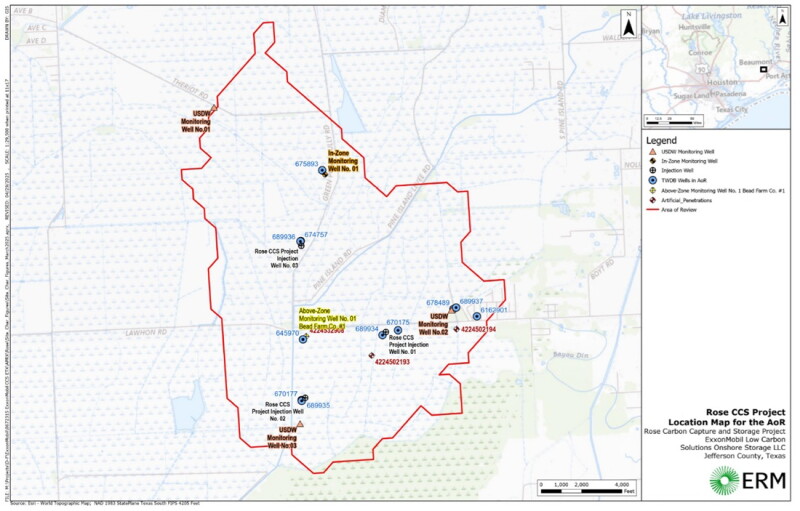
The Rose project is planned on 13,000 acres of privately owned land and is set to include three water-monitoring wells and one in-zone monitoring well in addition to the three CO2 injection wells. CO2 storage is planned to take place between 0.5 and 1.5 miles below the surface, and an 18-mile pipeline is planned to connect the captured CO2 to the storage area.
In addition to the injection and monitoring wells, which were drilled in 2024, two previous wells were identified in the area that intersected the UCCZ—one legacy well and the project’s stratigraphic test well. The MRV plan says that “corrective actions were undertaken for both penetrations to prevent fluid movement that could endanger USDWs [underground sources of drinking water].”
The plan says, “Each well was re-entered, and appropriate barriers were installed at critical intervals. Barriers were installed at the UCCZ, surface casing shoe, base of the lowermost USDW, and the wellhead for the legacy well.”
The legacy well was re-entered and plugged and abandoned on 14 March 2025. The stratigraphic test well was converted into an above-zone monitoring well on 7 February 2025.