Acidizing/stimulation

This paper reviews fracturing-program design, completion technology, real-time data collection, data integration, and lessons learned for the Pikka development on the North Slope of Alaska.

The paper describes a project in which extremely challenging stimulations were performed in a fractured tight carbonate in a complex strike/slip stress faulting regime with high tectonic stresses.

The works highlighted in this year’s Acidizing feature demonstrate novel, diverse innovations in sustainability, enhanced productivity, and logistical efficiency by authors of SPE conference papers.
-
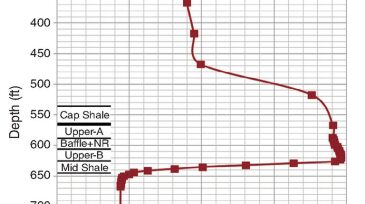
 Cyclic steam stimulation (CSS) is one of the principal enhanced-oil-recovery methods for heavy oil. CSS was performed in some of the wells of a heavy-oil field in Kuwait. Multiple cycles were applied in these wells. However, the total water produced in each cycle was much less than expected.
 -
The treatment in a deepwater, frac-packed well with fiber-optic-equipped coiled tubing (CT) and a rotating, hydraulic high-pressure jetting tool achieved successful stimulation of a 500-ft-long frac-packed zone after several previous failures using different techniques.
-
This paper discusses a novel approach to abrasive perforating, including the first-ever use of an acid-soluble abrasive material and ending with CT-jetting-assisted nitrified stimulation.
-
This paper describes the testing of a novel concept based on resistivity measurements to monitor acid-stimulation operations.
-
Tight formations are candidates for hydraulic fracturing as the default. However, the solubility of carbonate by various chemicals provides opportunities to extend the well drainage radius effectively without the intensive equipment, material, and infrastructure demand of hydraulic fracturing.
-
This paper summarizes a wide variety of sandstone-acid-stimulation case histories, highlighting aspects such as mechanical conditions and operational practices.
-
This paper presents experimental and field-case studies with a sandstone-acidizing treatment designed to retard the hydrofluoric acid reaction rate and enable single-stage treatment.
-
This paper studied three residual-free fluid systems for acid treatments and fracturing in order to develop no-damage or reduced-damage and highly effective stimulation techniques for long-interval wells.
-
While there is increased scrutiny from regulatory and community stakeholders on the chemicals used in operations, complex and technically challenging reservoirs must be developed to replace reserves. Matrix stimulation remains a critical technology for delivering barrels at minimum cost.
-
Carbon dioxide (CO2) with 30% foam quality (FQ) has been introduced for the first time during acid fracturing treatments in a tight, sour, high-pressure/high-temperature carbonate gas reservoir in Saudi Arabia.