AI/machine learning

The deals, with a potential value exceeding $3.7 billion, are aimed at strengthening Saudi Aramco’s supply chains and expanding its use of industrial artificial intelligence.

This work applies fuzzy logic, a well-established artificial-intelligence technique, to quantitatively assess connectivity between injectors and producers in a giant presalt field in the Santos Basin of Brazil.

The DOE-backed EGS-Twin project aims to simulate geothermal production systems, helping operators better predict performance and maximize output.
-
 Rapid advances in deep learning continue to demonstrate the significance of end-to-end training with no a priori knowledge. However, when models need to do forward prediction, most AI researchers agree that incorporating prior knowledge with end-to-end training can introduce better inductive bias.
 -
Total plans to start a digital factory to tap artificial intelligence in a bid to save hundreds of millions of dollars on exploration and production projects, according to an executive.
-
New funding for a chatbot technology, or smart assistant, represents the latest development in the Norwegian operator’s drive toward digitalization.
-
AGI stands for artificial general intelligence, a hypothetical computer program that can perform intellectual tasks as well as, or better than, a human. AGI will make today’s most advanced AIs look like pocket calculators.
-
Dubbed the technology of the decade, AI has been the catchphrase on every futurist’s tongue. From customer support chatbots to smart assistants, AI has begun to transform numerous industry verticals.
-
Machine-learning methods have gained tremendous attention in the last decade. The underlying idea behind machine learning is that computers can identify patterns and learn from data with minimal human intervention. This is not very different from the notion of automatic history matching.
-
While both are raw resources, data is reusable. A CERAWeek panel said infrastructure and cultural change are needed to drive the transformative value of data.
-
HSE data is ever growing, especially in high-risk industries. So, how can you apply data science and artificial intelligence to help see beyond current practices and gain even greater insights into safety data?
-
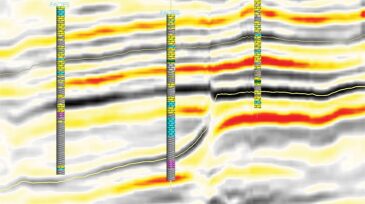
This paper discusses a project with the objective of leveraging prestack and poststack seismic data in order to reconstruct 3D images of thin, discontinuous, oil-filled packstone pay facies of the Upper and Lower Wolfcamp formation.
-
In this study, the authors investigated a fully data-driven approach using artificial neural networks (ANNs) for real-time virtual flowmetering and back-allocation in production wells.