AI/machine learning

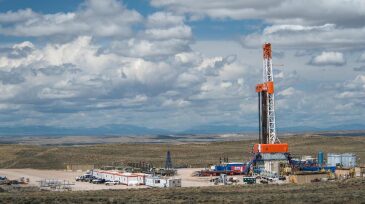
Chevron and Halliburton describe how they built and deployed the fully autonomous closed-loop fracturing system that enables subsurface-driven optimization.
Aramco says it has saved $770 million over the past 3 years from the $70 million it has invested over the same period in corrosion management technologies.

The deal adds physics-based reservoir modeling and real-time decision workflows to SLB’s digital portfolio.
-
 A study of 25 years of artificial-intelligence research suggests the era of deep learning may come to an end.
 -
Leading corporations seem to be failing in their efforts to become data-driven. This is a central and alarming finding of NewVantage Partners’ 2019 Big Data and AI Executive Survey.
-
BP Ventures has invested $5 million in Belmont Technology’s Series A financing to further bolster BP’s artificial intelligence and digital capabilities in its upstream business.
-
The technology is being proven in millions of phones and homes across the world. Now, a small group of software startups wants to introduce chat bot technology to oil and gas professionals.
-
Royal Dutch Shell is heavily investing in research and development of artificial intelligence, which it hopes will provide solutions to some of its most pressing challenges.
-
Artificial intelligence has come to the oil patch, accelerating a technical change that is transforming the conditions for the oil and gas industry’s 150,000 US workers.
-
An increasingly buzzy term tossed around at industry events, “digital twin” is leveraging data analytics, machine learning, and artificial intelligence to improve efficiencies from design to decommissioning.
-
Researchers borrowed equations from calculus to redesign the core machinery of deep learning so it can model continuous processes like changes in health.
-
As shale plays are becoming economically viable, operators have fast-adopted best practices to optimize drilling and completion processes to drive down the lifting costs. Adoption of data-driven analytics to improve completion design, drive efficiency, and yield economic gains has been less swift.
-
Digitalization in the oil and gas industry has been the focus of much discussion, but little has been written on the slow rate of adoption. This paper outlines some of the barriers the industry faces as it assimilates into Industry 4.0—automation and data integration in manufacturing.