AI/machine learning

Known as Arena, the collaboration aims to improve decision-making across increasingly complex reservoirs and growing volumes of subsurface data.

Robotic and autonomous systems are transforming energy operations, but their full value emerges only when paired with data science, engineering analytics, and AI/ML to turn data into decisions. The transition of the SPE Robotic & Autonomous Systems Technical Section into the SPE Data Science & Engineering Analytics Technical Section helps bridge this critical technolo…
A credible custody-transfer record depends on far more than the accuracy of a single meter. It is the product of an integrated measurement chain. While meter performance supports measurement-system integrity, commercial confidence also depends on traceability, governance, and authorization.
-
 This article explores the implementation of artificial intelligence vision for leak monitoring automation in the oil and gas industry and its role in improving safety standards, operational efficiency, and environmental performance.
-
This paper investigates the use of machine learning to rapidly predict the solutions of a high-fidelity, complex physics model using a simpler physics model.
-
This study proposes a hybrid model that combines the capacitance/resistance model, a machine-learning model, and an oil model to assess and optimize water-alternating-gas (WAG) injectors in a carbonate field.
-
The partnership aims to use artificial intelligence and advanced robotics to accelerate the adoption of technologies for predictive maintenance.
-
The new AIQ ownership structure will see Presight acquire 51% shareholding, with ADNOC retaining 49% and receiving a 4% stake in Presight. AIQ will continue to operate as a standalone company.
-
Developing alternative power supplies with wide-scale reliability, dependability, and minimization or elimination of GHG emissions within feasible capex/opex scenarios is the brass ring of sustainability and energy security—and data are helping us get there.
-
This paper presents the design and development of a prototype intelligent water-injection and smart allocation tool aimed at achieving autonomous waterflood operations.
-
In the pursuit of sustainable industrial operations, three pivotal objectives emerge: risk reduction, safety assurance, and cost minimization. Integrating these objectives into digital transformation strategies enables operators to effectively manage emissions and achieve success.
-
Supervised learning was used to develop an ensemble of models that account for historical production data, geolocation parameters, and completion parameters to forecast production behavior of oil and gas wells.
-
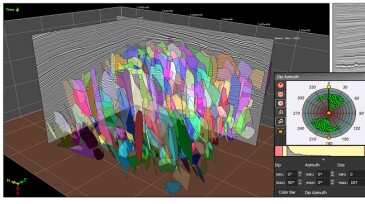
The combined effort aims to reduce the time necessary for and increase the detail and accuracy of seismic interpretation, including for carbon sequestration studies.