AI/machine learning

Known as Arena, the collaboration aims to improve decision-making across increasingly complex reservoirs and growing volumes of subsurface data.

Robotic and autonomous systems are transforming energy operations, but their full value emerges only when paired with data science, engineering analytics, and AI/ML to turn data into decisions. The transition of the SPE Robotic & Autonomous Systems Technical Section into the SPE Data Science & Engineering Analytics Technical Section helps bridge this critical technolo…
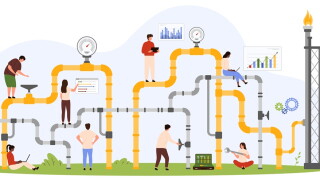
A credible custody-transfer record depends on far more than the accuracy of a single meter. It is the product of an integrated measurement chain. While meter performance supports measurement-system integrity, commercial confidence also depends on traceability, governance, and authorization.
-
 Artificial intelligence is prompting oil and gas companies to redefine roles, rethink trust, and rework operations, experts said during CERAWeek.
-
The gap between machine learning research and effective deployment in the oil and gas industry is an alignment challenge between research questions and real decisions, between model design and operational constraints, and between innovation and the people expected to use it.
-
Technology and partnerships remain important, while phased approaches may supplant lengthy appraisal programs, experts said during CERAWeek.
-
CERAWeek panelists see AI as a way to leverage data and people in interpreting data for exploration, but a cultural shift at companies may still be needed.
-
This paper describes an approach to creating a digital, interconnected workspace that aligns sensor data with operational context to place the completions engineer back into a central role.
-
This paper demonstrates how the integration of multiphysics downhole imaging with machine-learning techniques provides a significant advance in perforation-erosion analysis.
-
This paper presents a workflow that leverages a multiagent conversational system to integrate data, analytics, and domain expertise for improved completion strategies.
-
Examples demonstrate how an Integrated Operations Center as a Service (IOCaaS) model, powered by artificial intelligence, reduced costs by 5% and increased production by 6% in Canada.
-
The authors propose a deep-learning-based approach enabling near-real-time CO2-plume visualization and rapid data assimilation incorporating multiple geological realizations for predicting future CO2 plume evolution and area-of-review determination.
-
The newest recipient of the title SPE Legend of Hydraulic Fracturing talks about his career, the evolution of fracture stimulation, the development of increasingly useful simulators, and the future of the oil and gas industry. The honor was given at the 2026 SPE Hydraulic Fracturing Technology Conference and Exhibition.