Artificial lift
This article from the SPE Artificial Lift Technical Section highlights a positive reality of our industry, one that centers on connecting and collaborating for success.

This case study describes how edge computing and industrial internet of things platforms were deployed to automate and optimize production operations across four distinct basins.
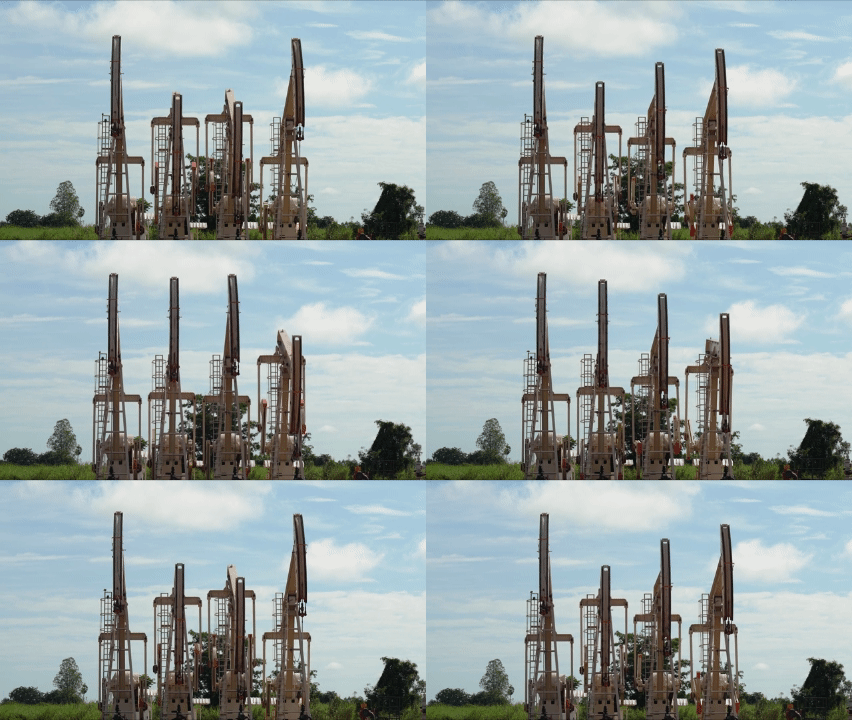
This paper proposes a novel, real-time pump failure prediction method using machine learning with scaled load ratio to accurately predict pump failures using only surface pump load data.
-
 Rockwell Automation’s Luis Gamboa explains his company’s new solution designed to allow operators to collect, sort, and reconcile the quality and quantity of data from multiple sources to optimize field data.
 -
Two things stood out when I looked at this year’s abstracts. First, well over half of the abstracts were related to electrical submersible pumps (ESPs). This is a significant increase from the last couple of years. Second, there was a clutch of artificial-lift-method-selection papers.
-
This paper focuses on a fit-for-purpose methodology to evaluate well-production performance for a wide range of artificial-lift techniques.
-
This paper presents an artificial-lift selection process to maximize the value of unconventional oil and gas assets.
-
This study presents a methodology to define the most-adequate artificial-lift technique on the basis of technical limitations, a suitability coefficient (based on an attributes table), and economic analysis toward horizontal well configuration.
-
With Over 200 Shale Well Installs, This Slug-Smoothing Lift Technology Is Boosted By Schlumberger JVSlug flow has made the life of an unconventional production engineer a bit complicated, but a new downhole technology may smooth things right out by solving some big artificial lift problems for the shale sector.
-
Unconventional production patterns in the Permian Basin are leading producers to replace electrical submersible pumps (ESPs) with gas lift, which had been little used there.
-
The 2016 SPE Legends of Artificial Lift are announced. Recipients will be honored at the 2016 SPE Artificial Lift Conference and Exhibition for North America to be held this month.
-
The sharp downturn in the offshore oil business has sparked interest in using subsea pumps to add production. If those conversations turn into orders, it may convert this rarely used option into a commonly used tool for extending the life of offshore fields.
-
Our problem is that we are dealing with multiphase, multicomponent fluids whose compositions change spatially and temporally inside imperfectly understood heterogeneous reservoirs whose characteristics also change spatially and temporally.