Completions

Industry experts at URTeC assessed more than a decade of unconventional growth while discussing where productivity gains will come from next.

Chevron and Halliburton describe how they built and deployed the fully autonomous closed-loop fracturing system that enables subsurface-driven optimization.

Weatherford CEO Girish K. Saligram said the acquisition will bolster Weatherford’s completions offerings and unconventional reservoir capabilities.
-
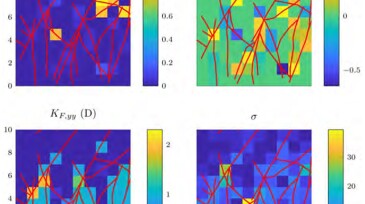
 This paper analyzes several configurations of convolutional neural networks suited for predicting upscaled fracture permeabilities and shape factors required to close a dual porosity/dual permeability model.
 -
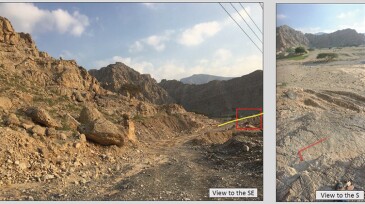
The authors write that simple and straightforward observations on outcrops can be used to build 3D models that mimic geological relationships accurately.
-
In this paper, a complete safety-management approach and a contingency plan are developed for carbon dioxide waterless fracturing operations.
-
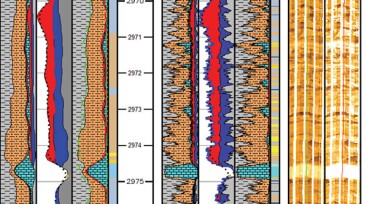
This paper presents an integrated work flow to model mechanical properties at sufficiently high resolution to honor accurately rock fabric and its effects on height and complexity and, thus, production.
-
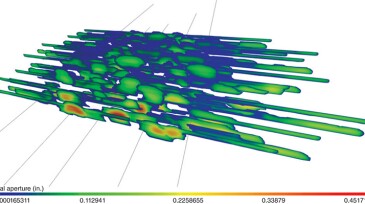
In the past decades, the success of unconventional hydrocarbon resource development can be attributed primarily to the improved understanding of fracture systems, including both hydraulically induced fractures and natural fracture networks. To tackle the fracture characterization problem, several recent papers have provided novel insight into fracture modeling techniq…
-
Insights from an ongoing industry study on North American shale wells help explain what frac hits, or fracture-driven interactions, are doing between offset wells, and why.
-
SponsoredShell needed an easy-to-use, simple well monitoring solution. Could an IoT wireless solution measure up to a classic wired approach?
-
The pressure pumping business has been looking up this year, but the price paid to buy a big player in that business, FTS International, suggests growth may not last.
-
The deal represents what will become the second deployment of an all-electric fracturing fleet built by Halliburton and with power supplied by VoltaGrid's microgrid technology.
-
This paper presents lessons learned and best practices from several chemical sand-consolidation and sand-agglomeration treatments performed in mature fields in Malaysia.