Completions

Industry experts at URTeC assessed more than a decade of unconventional growth while discussing where productivity gains will come from next.

Chevron and Halliburton describe how they built and deployed the fully autonomous closed-loop fracturing system that enables subsurface-driven optimization.

Weatherford CEO Girish K. Saligram said the acquisition will bolster Weatherford’s completions offerings and unconventional reservoir capabilities.
-
 While storage and logistics are critical elements of the viability of water reuse, if the water chemistry is not fit for gel fracturing formulations, it will not matter how much is stored in centrally located impoundments.
 -
Evenly fracturing all clusters in heterogeneous zones is challenging in long horizontal sections penetrating heterogeneous reservoirs, as is often the case in the Eagle Ford shale.
-
An innovative approach resulted in the development of an ultra-HP/HT permanent bridge plug for long-term exposure at 25,000‑psi pressure and temperatures of 500°F.
-
This paper attempts to describe some of the common problems and to help prevent some common errors often observed in diagnostic fracture injection tests (DFITs) execution and analysis.
-
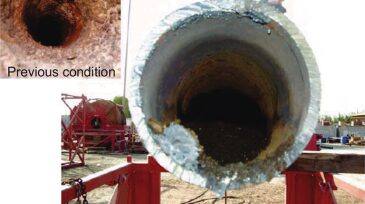
The gas-producing carbonate zones of the Ghawar field in eastern Saudi Arabia have been affected by extensive iron sulfide (FeS) scale deposition, reducing overall gas production and increasing risks during well interventions.
-
Refracturing older unconventional wells is likely to reward those willing to investigate the reasons why production declines and what can be done to restore it, according to George King, distinguished engineering adviser at Apache Corp.
-
The offshore industry has taken another step toward opening up new deepwater frontiers to exploration with Maersk Drilling ordering the first 20,000-psi blowout preventer (BOP) made by GE Oil and Gas.
-
Running a shale exploration and production operation requires a sharp focus on costs, but not all are measured the same.
-
This paper describes a modeling technique by which hydraulic fractures are represented as part of the well model rather than as any form of refinement in the simulation grid.
-
Many problems that result in BOP downtime could be prevented if only drilling contractors knew which parts of the subsea system to replace and when. BOP monitoring systems have been developed to increase reliability by enabling preventive maintenance.