Completions

This edition highlights three offshore technology papers that address a common industry theme: how targeted engineering solutions can reduce uncertainty, shorten operations, and make technically constrained offshore well activities more executable.

Three papers are highlighted as the primary contributions because of their broad industry relevance. They focus on improving formation particle-size characterization, expanding the application of openhole gravel packs in depleted and compartmentalized reservoirs, and advancing the understanding of capillary pressure in sand production.

This paper aims to establish a set of best practices for generating particle-size-distribution data from core samples.
-
 Murphy Oil has created a work flow to normalize the tags it uses when collecting data on its hydraulic fracturing stages. The work flow described here empowers decision makers, who no longer wait for hours to collect data or waste hours cleaning and preparing data for analysis.
 -
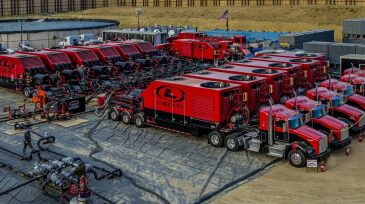
The all-stock deal doubled Liberty’s working pressure-pumping capacity without adding any debt to its balance sheet, while Schlumberger retains a 37% equity interest.
-
A trio of field studies recently presented at the 2020 SPE Annual Technical Conference and Exhibition highlights in different ways how emerging technology and old-fashioned problem solving are moving the industry needle on proppant and conductivity control.
-
An investigation of casing damage led Chesapeake Energy and Well Data Labs to identify patterns in the treating pressure data that are useful markers when trouble is likely.
-
With only around 30 installations worldwide, ADNOC’s onshore team has seen enough results from its first “fishbone” stimulation to embark on a 10-well program that will decide a full development scheme.
-
The average geothermal gradient in the subject deepwater field in Nigeria is 4.37°C/100 m, nearly twice the gradient in most fields. As a result, the magnitude of the expected annular pressure buildup (APB) during steady-state production is large enough to threaten well integrity.
-
The complete paper describes the first implementation of a solution to control fracture height for conventional wells in the Pannonian Basin.
-
The complete paper discusses a geophone array, including four, three-component geophones deployed by wireline, that provides a solution for this problem by creating a 3D map of the acoustic environment.
-
Integrity (noun): the condition of having no part or element wanting; unbroken state; material wholeness, completeness, entirety. While reviewing the abstracts, I was struck by the huge range of challenges to maintaining “material wholeness” beyond the routine testing of tree and safety valves.
-
Skipping one traditional step in the supply chain might save oil and gas companies hundreds of millions of dollars a year while making a meaningful dent in emissions.