Completions

This edition highlights three offshore technology papers that address a common industry theme: how targeted engineering solutions can reduce uncertainty, shorten operations, and make technically constrained offshore well activities more executable.

Three papers are highlighted as the primary contributions because of their broad industry relevance. They focus on improving formation particle-size characterization, expanding the application of openhole gravel packs in depleted and compartmentalized reservoirs, and advancing the understanding of capillary pressure in sand production.

This paper aims to establish a set of best practices for generating particle-size-distribution data from core samples.
-
 Contractor renews incident-response partnership for 2 additional years.
 -
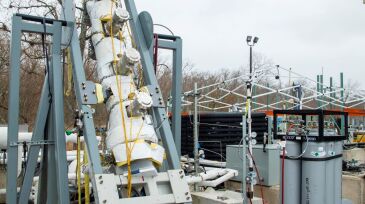
New Testing Facility Built To Prove Whether Natural-Gas Foam Is Shale Sector's Next Fracturing FluidA 6-year R&D project concludes with the completion of a technology kit designed to study how combining highly pressurized natural gas and water could be a holistic alternative to traditional hydraulic fracturing.
-
The qualification and first deployment of a low-solids, oil-based completion fluid that incorporates a newly developed, high-density brine as the internal phase to extend the density limit is discussed.
-
A pressure-monitoring technique using an offset sealed wellbore as a monitoring source has led to advancements in quantifying cluster efficiencies of hydraulic stimulations in real time.
-
S13Cr tubing specimens experienced stress corrosion cracking with phosphate-based completion fluids contaminated with mud and oxygen, whereas formate-based completion fluid is compatible with the tubing.
-
A well-flux surveillance method to monitor and ramp up production for openhole standalone screen completions is described that optimizes production by considering risks of production impairment and screen-erosion failure.
-
The deal fills a gap in the software developer's production line that is focused on drilling, production, and land management applications.
-
Is it possible to fracture a well using power off the grid? The answer is yes, but sharp electric engineers are required.
-
The two-well stimulation approach is delivering big savings to first adopters. A new report from Rystad highlights how the development is taking shape.
-
In striving to boost production of shale gas and tight oil, China is trying enhanced-hydraulic-fracturing technology and real-time data analysis in the Sichuan shale basin. In Daqing’s tight-oil fields, an alternative fracture-completion strategy and post-stimulation flowback technology has been tested.