Completions

This paper aims to establish a set of best practices for generating particle-size-distribution data from core samples.

This paper discusses the successful execution of two openhole gravel-pack completions in two Gulf of Mexico fields with depleted reservoirs.

This edition highlights three offshore technology papers that address a common industry theme: how targeted engineering solutions can reduce uncertainty, shorten operations, and make technically constrained offshore well activities more executable.
-
 Researchers at Yale University who analyzed groundwater wells in the Marcellus Shale area have determined that hydraulic fracturing is highly unlikely to be a direct source of contamination.
 -
This paper gives the recommended MSF horizontal-well spacing for several development scenarios in Saudi Arabian gas-reservoir environments.
-
As deeper and more complex well designs proliferate throughout oil and gas fields, well completion methods are challenged and new technologies are emerging to ensure safe, cost-efficient, and optimized completions.
-
Telok is a gasfield development in the Malay basin offshore Terengganu, Malaysia. This paper discusses the program learnings and operational improvements captured while completing eight new wells in 2012 and 2013.
-
Many of us have been so busy chasing the next well and the upcoming job that our skills in the area of optimizing our completions may have become a little rusty. Now is a great time to knock off that rust and revisit our best-laid plans.
-
An integrated approach to sand management is crucial to address sanding risk in producers and injectors in a North Sea mature field.
-
Chemical sand consolidation works by pumping chemicals downhole to strengthen the formation and stop sanding. In most cases reported in the industry, chemical consolidation has been used in short production intervals (less than 100 m).
-
A tight gas carbonate reservoir with no oil rim in a supergiant onshore gas field in Abu Dhabi was targeted for stimulation during a field review to increase field production.
-
To understand production from shale reservoirs, the role of hydraulically induced fractures, natural fractures, and their interaction in a formation must be captured.
-
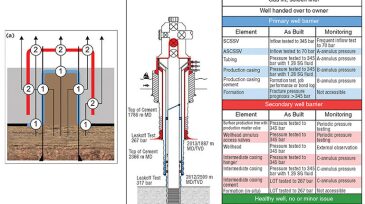
Well integrity and well barriers have been part of the exploitation for oil and gas for nearly a century, with the introduction of the blowout preventer (BOP) in the 1920s.