

Data & Analytics

The US supermajor will use Permian Basin natural gas to support the hyperscaler’s AI business.
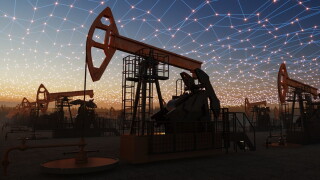
Analysis by the energy research firm sees the value of artificial intelligence growing for exploration and production companies, but the company said increased investment will be necessary.

This article from the SPE Robotics and Autonomous Systems Technical Section (RASTS) explores the insights shared at the recent Offshore Technology Conference (OTC) in Houston about autonomous systems and their role in the industry's future.
-
 In today’s era of asset management, digital twins are changing risk management, optimizing operations, and benefitting the bottom line.
 -
Digitalization and advanced analytics have enabled drilling automation that is changing the way wells are executed to deliver more production earlier.
-
Real-time wellhead monitoring aims to help Romania meet new EU methane emission regulations.
-
The supermajor’s Energy Outlook 2025 suggests geopolitical fragmentation could tilt the balance of the energy trilemma toward energy security and away from sustainability.
-
The companies said they plan to start deploying digital twin technologies in Oman this year.
-
This paper reviews the motivation and development of response-based forecasting from the perspective of the authors, reviewing examples and processes that have served as validation and led to modeling refinement.
-
The paper describes the deployment of fiber-optic monitoring of CO₂ injection and containment in a carbonate saline aquifer onshore Abu Dhabi.
-
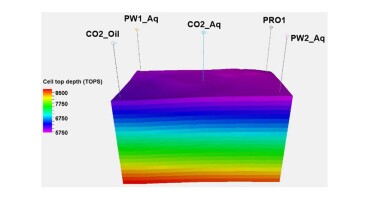
This paper presents a novel workflow with multiobjective optimization techniques to assess the integration of pressure-management methodologies for permanent geological carbon dioxide storage in saline aquifers.
-
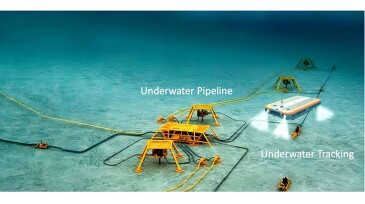
This paper introduces a technology for offshore pipeline inspection centered on an autonomous robotic system equipped with underwater computer vision and edge-computing capabilities.
-
Intelligent completions could improve many of the world’s oil and gas wells, but not all are suited to the technology. There is another option.




![JPT_2025-09_GuestEd1_SS_382853197[4].jpg](https://assets.spe.org/dims4/default/860913d/2147483647/strip/true/crop/850x475+0+46/resize/365x204!/quality/90/?url=http%3A%2F%2Fspe-brightspot.s3.us-east-2.amazonaws.com%2F8a%2F95%2Fe4e82cb54fd597d497a5b1267f8a%2Fjpt-2025-09-guested1-ss-3828531974.jpg)