Data & Analytics

Working with Dell Technologies and NVIDIA, the French supermajor is targeting improved seismic processing and artificial intelligence applications.

A discussion at the inaugural executive breakfast convened by the SPE Data Science and Engineering Analytics Technical Section, held alongside CERAWeek by S&P Global and powered by Black & Veatch, tackled the challenge of value creation from artificial intelligence in the energy industry.

AI‑driven data center growth is straining US power grids and accelerating interest in enhanced geothermal systems as a scalable, low‑carbon solution.
-
 Wearable computers are turning heads in the oil and gas industry and appear to be on a trajectory for widespread adoption.
 -
Ground sensors on assets over a broad area have limited returns on investment if the asset life cycle is less than 10 years, and obsolescence of the technology if it exceeds 10 years. Complementing sensors with aerial remote sensing at scale may help to mitigate these issues.
-
Unconventional operators are finally beginning to use to their advantage the nearly endless stream of data they’ve collected over the years. ConocoPhillips explains how it has seen real improvements in its operations by removing data friction and opening up access across typical work silos.
-
Two prominent security consultant firms estimate that energy companies, ranging from drillers to pipeline operators to utilities, invest less than 0.2 percent of their revenue in cybersecurity.
-
Unmanned aerial systems (UAS) are lightweight, low-cost aircraft platforms operated from the ground that can be outfitted with imaging or nonimaging payloads. UASs offer health, safety, and environment professionals a promising opportunity to reduce risks by keeping people out of harm’s way.
-
As leaders in digital drilling analysis push into real-time data analysis and digital controls, they are finally confronting data-quality problems. Humans are better than machines at dealing with ambiguous readings.
-
Energy companies are looking to distributed ledger technology—otherwise known as blockchain—to help navigate the complex transactional systems that make up their operations. What is blockchain, and what makes it valuable to our industry?
-
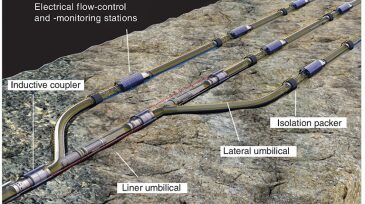
A producer and a service company have collaborated to develop a downhole system to merge multilateral technology and intelligent completions to create “smart laterals.”
-
What I find impressive is the number of people who were hiding in normal discipline jobs who are coming out of the closet with their Python scripts. And, it’s working. In many ways, order is coming to the mess, efficiency is coming to tiresome manual activities, and richness is coming to decisions.