Data & Analytics

Sponsored
With operators under pressure to deliver more energy with fewer resources, predictable drilling performance is more important than ever. Discover how a unified digital workflow can turn drilling data into better decisions and consistent execution—providing the foundation for autonomous drilling and more predictable, profitable, and productive wells at scale.
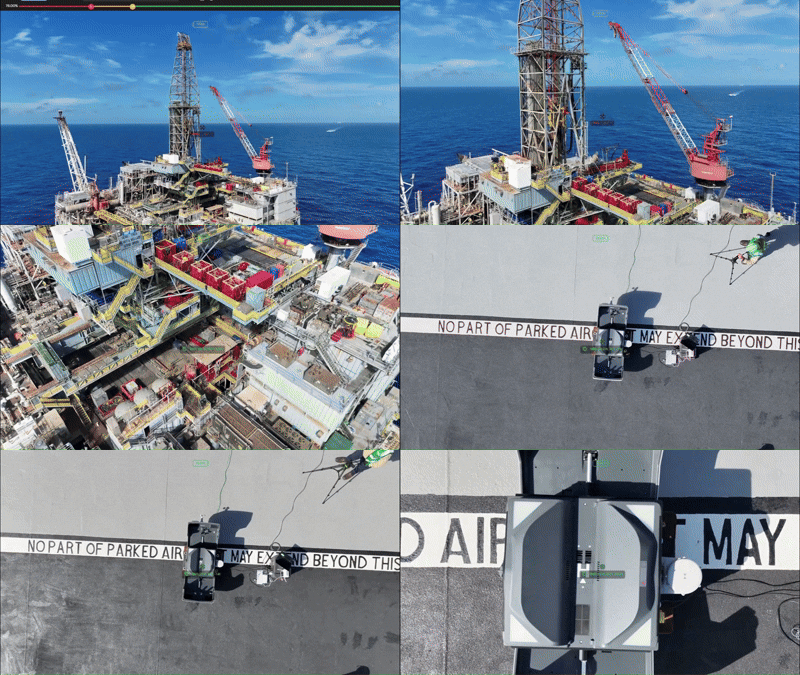
Shell has demonstrated drone-in-a-box operations from its Mars floating production unit, becoming the first operator in the region to secure FAA approval for self-approved offshore beyond-visual-line-of-sight flights. JPT Senior Technology Editor Jennifer Pallanich visited Shell Technology Center Houston to see the system in action.

Panelists at the SPE Subsea Well Intervention Symposium discussed where AI is delivering value today, where risks remain, and how engineers can best determine its usefulness.
-
 The paper presents the design and successful field deployment of the first closed-loop hydraulic fracturing program.
 -
Working with Dell Technologies and NVIDIA, the French supermajor is targeting improved seismic processing and artificial intelligence applications.
-
A discussion at the inaugural executive breakfast convened by the SPE Data Science and Engineering Analytics Technical Section, held alongside CERAWeek by S&P Global and powered by Black & Veatch, tackled the challenge of value creation from artificial intelligence in the energy industry.
-
AI‑driven data center growth is straining US power grids and accelerating interest in enhanced geothermal systems as a scalable, low‑carbon solution.
-
The authors describe a study on key technologies for intelligent risk monitoring of workover operations.
-
The authors write that by replacing outdated, labor-intensive processes with an integrated, cloud-based platform, companies can streamline planning, improve accuracy, and foster better coordination across teams and vendors.
-
The authors write that deployment of artificial-intelligence-based high-gas/oil ratio well-control technology enabled stabilization of well performance and maintenance of optimal production conditions.
-
The oil and gas industry is undergoing a significant shift with the advent of intelligent operations. This transformation is enabling upstream operations to move away from a reactive and manual mode of operation toward a more efficient, safe, and optimal state of operation.
-
EQT is benchmarking its way to basin-leading productivity and relying on partnerships and new technology to turn KPIs into operational reality.
-
This paper presents the first global application of autonomous drilling in deepwater and the journey to reach optimal drilling parameters, integrating proprietary tools from the project’s business partners.