Data & Analytics

Canada’s development of large-scale digital drilling core libraries and open geoscience data platforms follows approaches pioneered in Australia, particularly Western Australia, through decades of government investment in geoscience data collection and preservation.

This research focuses on combining physics-based expert rules with machine learning to improve the detection of failure-related events in electrical submersible pumps.

A combination of physics principles and machine-learning techniques is used in this work to develop a virtual flowmeter for oil-production optimization in electrical-submersible-pump-lifted oil wells, resulting in reliable generalization.
-
 Although early inflow control devices and intelligent completions (ICs) were introduced almost 20 years ago, completion technology has not kept pace with advancements in drilling technology.
 -
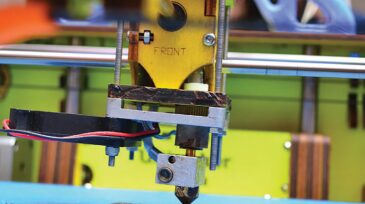
Researchers at Heriot-Watt University in Edinburgh, Scotland, are building replica core samples using 3D printers and installing sensors inside them as they go. Their goal is to directly monitor pore-scale flow behavior from the inside of these so-called “smart rocks.”
-
As the drilling industry improves its efforts to capture drilling operation activities in real time, it has generated a significant amount of data that drilling engineers cannot process on their own.
-
Autonomous underwater vehicles (AUVs) have demonstrated their capabilities during the search for Malaysian Airlines flight 370 in the Indian Ocean.
-
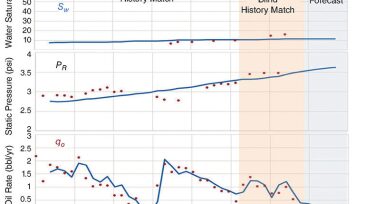
Young Technology Showcase—Top-Down Modeling: A Shift in Building Full-Field Models for Mature FieldsData-driven, or top-down, modeling uses machine learning and data mining to develop reservoir models based on measurements, rather than solutions of governing equations.
-
Well control is built around huge steel machines, but the future of the business is digital. Data have become a critical asset as operators and service companies work to increase the safety and reliability of their products and operations.
-
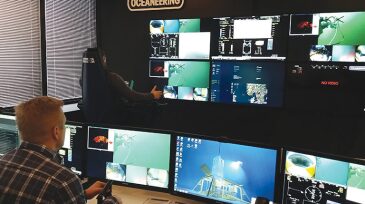
Operators for remotely operated vehicles will be getting more remote in the future as land-based control begins to become a reality.
-
A real-time method is presented to predict impending stuck pipe with sufficient warning to prevent it. The new method uses automated analysis of real-time modeling coupled with real-time-data analysis.
-
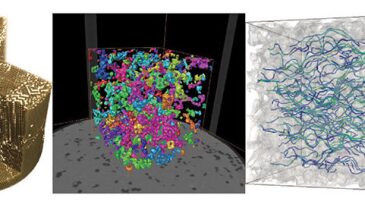
In an effort to foster collaboration in an area where there is currently very little, researchers at the University of Texas at Austin (UT) created a new web-based application for storing and sharing CT images of rocks.
-
Low prices require doing things differently. It is a hopeful sign for the future for innovators who have been struggling to keep going and have potential customers with little to spend and a lot to worry about.