Data & Analytics

Switching from continuous circulation to cyclic huff-‘n’-puff operation in enhanced geothermal systems can significantly delay thermal breakthrough, sustain higher production temperatures, and improve long-term economic performance.

The two companies say they plan to work together to use agentic AI to increase the capabilities of technical experts.

This article is the first in a Q&A series from the SPE Methane Emissions Management Technical Section (MEMTS) on methane intelligence and how oil and gas teams translate emissions data into credible decisions and measurable reductions.
-
 As the world’s top oil producers prepared for a weeklong meeting in April to plan a response to slumping prices of crude, espionage hackers commenced a sophisticated spearphishing campaign that was concentrated on US-based energy companies.
 -
The future of intelligent operations in our industry is being driven by advances from other sectors that have been embraced for petroleum applications. Foundational changes already taking place include advances in the type and volume of data being acquired and how the data are used.
-
The complete paper presents a discussion of the use of intelligent well completion in Santos Basin Presalt Cluster wells.
-
This paper describes an automated work flow that uses sensor data and machine-learning (ML) algorithms to predict and identify root causes of impending and unplanned shutdown events and provide actionable insights.
-
Increasing accuracy in models is often obtained through the first steps of data transformations. This guide explains the difference between the key feature-scaling methods of standardization and normalization and demonstrates when and how to apply each approach.
-
Rapid development of more-accurate simulator engines has given researchers the opportunity to generate sufficient data to train robotic policies for real-world deployment. However, moving from simulation to reality remains one of the greatest challenges of modern robotics.
-
Researchers have created software that borrows concepts from Darwinian evolution, including “survival of the fittest,” to build AI programs that improve generation after generation without human input.
-
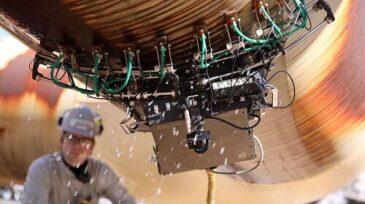
Gecko Robotics is providing the energy industry with artificial-intelligence-enabled robots to inspect infrastructure and supply massive amounts of data to help predict failures before they occur.
-
The AI journey starts with a single step, but too many companies take the wrong first step.
-
The words "disruption" and "change" are becoming more and more common in many industries, including offshore oil and gas.