Data & Analytics

This research focuses on combining physics-based expert rules with machine learning to improve the detection of failure-related events in electrical submersible pumps.

A combination of physics principles and machine-learning techniques is used in this work to develop a virtual flowmeter for oil-production optimization in electrical-submersible-pump-lifted oil wells, resulting in reliable generalization.

This paper presents the deployment of an artificial intelligence-enabled autonomous gas lift optimization system, integrating real-time centralized advanced process control with cloud-based analytics to enhance artificial gas lift performance in producer wells.
-
 This work describes a study in which distributed data parallel training, paired with a node-local caching pipeline, enabled efficient multigraphics-processing-unit scaling for a CO₂-storage graph-neural-network surrogate while maintaining generalization.
 -
This paper presents a novel reservoir engineering/reservoir simulation approach—a data-driven interwell-connectivity model augmented as a digital twin—to predict reservoir dynamics and optimize operations in the Changqing oil field of China.
-
This work uses a novel pseudosteady-state-based simulation to reduce training-data-generation cost while maintaining high-performance predictions of data-driven proxy models for carbon-sequestration projects.
-
This paper introduces in-pipe inspection technologies enabling high-resolution digital measurements of tubular internal diameter and wall thickness for critical downhole applications.
-
This case study describes how edge computing and industrial internet of things platforms were deployed to automate and optimize production operations across four distinct basins.
-
The US supermajor will use Permian Basin natural gas to support the hyperscaler’s AI business.
-
Analysis by the energy research firm sees the value of artificial intelligence growing for exploration and production companies, but the company said increased investment will be necessary.
-
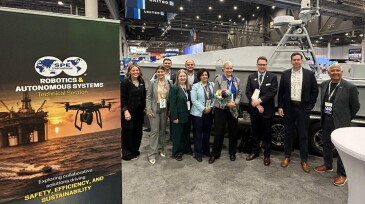
This article from the SPE Robotics and Autonomous Systems Technical Section (RASTS) explores the insights shared at the recent Offshore Technology Conference (OTC) in Houston about autonomous systems and their role in the industry's future.
-
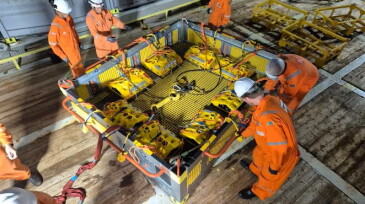
The technology has passed its first phase of qualification, with 84 nodes placed on the seafloor at a depth of 2,000 m to acquire 4D seismic data in the pre-salt Santos Basin.
-
The company says its curated service aims to connect energy professionals, developers, and partners to discover, deploy, and scale trusted AI agents, domain models, and digital applications.