


Technical Section Editorial
JPT’s Technical Section Editorial series features insights from committee members across SPE’s technical sections. Articles examine technical priorities, key activities, and emerging challenges within specific disciplines, providing SPE members with clear insight into how industry experts and volunteers are helping define SPE’s technical direction. Collectively, the series reflects the depth of SPE’s technical community and its continued commitment to advancing knowledge-sharing across the upstream energy sector. Learn more about the SPE Research and Development Technical Section (RDTS) on the RDTS SPE Connect Page.
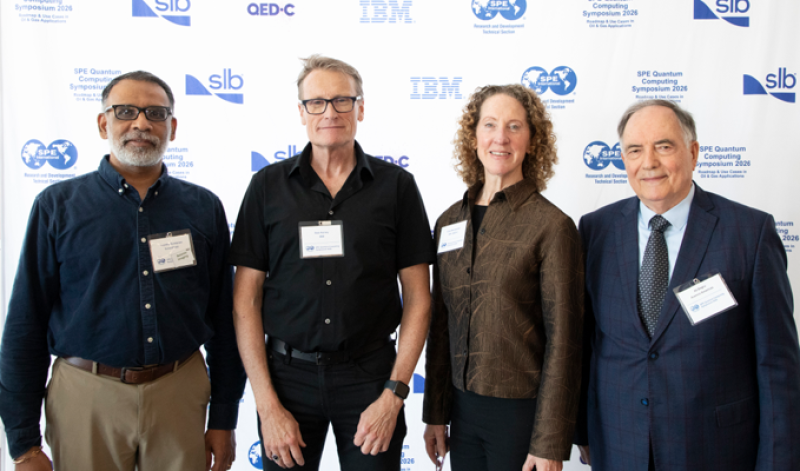
The rapid emergence of the disruptive technology of quantum computing (QC) opens up new opportunities for oil and gas computational problems. In response, the SPE Research and Development Technical Section (RDTS), in partnership with the Quantum Economic Development Consortium (QED-C), held a symposium at Rice University in May to identify the most prospective quantum computing use cases for oil and gas. Sponsored by QED-C, IBM, and SLB, the event brought together participants with a balanced mix of energy and QC expertise.
Quantum computing industry representatives reviewed the current state and outlook for emerging hardware and software. Participants then examined how these technologies could be applied to oil and gas challenges.
Quantum computing is not yet ready to replace high-performance computing in oil and gas workflows, but the industry needs to begin identifying where it may matter first. We identified the following use cases, which present long-standing challenges for the industry.
- Seismic imaging: elastic waveform simulation
- Simulation and modeling: new materials design and reservoir simulation
- Production optimization: hydraulic fracture optimization and well intervention strategy
Background
For the past several decades, a fundamentally new and powerful computing technology has been emerging from laboratories across the world—QC. While quantum mechanics is fundamental to the behavior of semiconductors that are the physical basis of modern digital technology, QC relies on a more fundamental property of quantum systems—the superposition of quantum states.
Classical systems are in only one well-defined physical state. The bit in a computer memory is either a 0 or a 1, and there are no intermediate values.
A quantum state can be built out of arbitrary superpositions, with defined phases of multiple underlying states, in much the same way that the surface of a pond can hold many different wave structures, with different wavelengths and phases, at the same time.
Quantum computing relies on the manipulation of these superposed states and thus uses a logic quite different from the bit logic of classical computers. Because the states are superposed, quantum computers effectively conduct multiple calculations in parallel.
For the right problems, the number of such calculations can be exponential in the number of underlying states, or qubits, well beyond the scale of conventional massively parallel processing. However, extracting a useful answer requires the algorithm to concentrate this parallelism onto a single or small number of desired results.
Quantum computers may be able to solve problems that are too large or impractical for classical computing to address. In 1994, Peter Shor demonstrated that there was a quantum algorithm that would perform large-value prime number factorization on practical time scales.
Since modern encryption techniques, both in banking and in national security, are based on public key cryptography, which relies on the practical impossibility of such factorizations with classical computers, this discovery motivated considerable research and now commercial investment in developing quantum computers.
Quantum Computing Hardware
There are multiple possible physical realizations of quantum computers, roughly divided by whether the qubits are natural (e.g., atoms, ions, photons) or synthetic (e.g., superconductors or semiconductors). These systems operate at extremely low temperatures to minimize the thermal noise. In addition, one needs optical laser, microwave, or electronic methods of reading and writing to the qubits. The most popular investment area for big companies (e.g., Google, IBM, Amazon, Chinese technology companies) is superconducting circuits.
A major constraint on quantum computers is the tendency of quantum phases to be disrupted or decohered by thermal fluctuations or material imperfections.
This drives the need for strong error correction, so that the number of logical qubits that can actually perform calculations is much smaller than the number of physical qubits. Current machines provide up to 1000 physical qubits, but significantly fewer than 100 logical qubits, with vendor roadmaps projecting millions of physical and thousands of logical qubits by 2030, enough for serious quantum computation.
In the near term, quantum computers will be noisy systems hybridized with classical computing, requiring careful handling to generate useful results.
Quantum Computing Applications
The most promising applications of quantum computing combine high value and high complexity, falling into one or more of these categories:
Quantum native problems: The 20th-century physicist Richard Feynman famously remarked that the best application of quantum computers would be in the simulation of quantum systems. This has motivated applications of QC in simulating the structures and functions of complex, highly quantum materials such as catalysts or proteins. Problems involving quantum states, quantum chemistry, wave propagation, or related physics can be naturally represented in a quantum framework.
Highly combinatorial problems: When the search space of a problem is enormous, the parallel behavior of quantum algorithms, alluded to above, comes into its own. The prime number factorization problem mentioned above is an example. Other examples of problems involving large search spaces include scheduling, routing, allocation, scenario ranking, and optimization under multiple constraints.
Problems in which the answer is intrinsically a probability distribution: These problems often aim to develop ranked possibilities, probability distributions, uncertainty envelopes, or candidate solution sets.
It is difficult to input or output large amounts of data to a quantum computer, which are thus advantaged when the amount of calculation is large, but input/output are limited in size. Quantum computing is currently best suited for problems complementary to those being addressed by big data or machine learning methods.
RDTS Quantum Computing Symposium
Quantum computing has, in the past few years, attracted more than $50 billion of investment, with the US, China, UK, Europe, and Japan leading in both private and public funding. Oil and gas companies have started small-scale research into the potential of such machines to address problems native to our industry, which is rich in large-scale computational challenges that are difficult to address with conventional technologies.
For this reason, RDTS convened a workshop to scope the likely impact of this technology on oil and gas challenges. The symposium attracted more than 80 registrants from the technology sector, government, academia, the oil and gas industry, and, especially, students interested in careers in energy and oil and gas.
The goals of the workshop were:
· Identify prospective oil and gas use cases, to stimulate reflection in the industry, including the service sector, about the degree of pre-investment appropriate to ensure that the industry can exploit business-critical quantum computing opportunities in a timely manner
· Educate the oil and gas participants about the fundamental science and engineering, including software engineering, of quantum computing
· Understand the consensus in the quantum computing industry of the roadmap to commercially relevant quantum computing capabilities
After overall welcomes from Thomas Halsey, a professor representing Rice University, Jeff Bailey, chair of RDTS, and Celia Merzbacher, executive director of QED-C, the workshop mixed lectures, panel discussions, and breakout groups.
Highlights included lectures from Professor Chris Monroe, founder of IonQ, and Martin Roetteler, a commercialization executive at IonQ, who emphasized the need for QC machines and algorithms to integrate seamlessly with existing classical software and workflows to achieve real-world impact. Xiaojun Huang, a chief engineer at ExxonMobil, addressed the outstanding computational challenges of the oil and gas industry.
Bob Parney of IBM gave an overview of the most prospective oil and gas areas for QC. Jyotsna Sharma, a professor from LSU, and Divakar Vashisth of Stanford University reported early results using quantum algorithms to address a number of oil and gas use cases, especially seismic imaging and interpretation and remote sensing of oil spills.
Rima Oueid of the US Department of Energy reviewed quantum computing readiness across major industries, noting that finance, pharmaceutical, and materials discovery have been most aggressive in preparing for quantum computing, followed closely by automotive, aerospace, logistics, and energy industries. There were also lively panel sessions on software issues for quantum computers as well as barriers to uptake of this technology.
To high-grade oil and gas use cases, parallel tracks of breakout discussions addressed the three areas of seismic Imaging, simulation and modeling, and production optimization. The participants in each track were charged with identifying topics that were both high value to the industry and for which QC might materially improve computational power and results.
The five potential use cases identified by the breakout groups were as follows:
Elastic Waveform Simulation
Elastic waveform simulation is a key intermediate step in modern seismic imaging approaches such as full waveform inversion (FWI). These workflows, while they promise much more accurate and detailed subsurface images, are also slow, often taking months to process a high-end survey.
The value of QC would be in speeding up processing. A major challenge of applying QC will be appropriate encoding of the large data sets and integration with the classical parts of the algorithm, such as comparison to data. Researchers in this area will need access to representative data sets, which has always been a challenge for FWI research.
New Materials Design
Improved material performance, especially for catalysts and active materials, has always been a high-value target for oil and gas, petrochemicals, and adjacent industries. Examples include classic refining and petrochemicals catalysts as well as more modern materials such as metal-organic frameworks, which may enable applications such as low-cost carbon separation.
While machine learning methods have made it easier to analyze large data sets of materials performance against various targets, our underlying ability to simulate the quantum behavior of large molecular structures has improved only incrementally over the past few decades. Simulation of the behavior of large (thousands of atoms) molecules and complexes is a holy grail of quantum computing.
Porous Media Flow Simulation
Reservoir simulation, based on the flow of fluids through porous media, is central to many workflows in hydrocarbon development and production. But current simulation methodologies are often too slow to impact business decisions, or cannot fully treat subsurface uncertainty.
A key step in modeling this flow is solution of large, sparse, linear systems. Solution of linear systems with QC is currently an active area of academic research and startup innovation. There are a variety of standard reservoir models available as a basis for research, but reservoir subject-matter expertise is required to develop integrated solutions that can impact business.
Hydraulic Fracturing Optimization
While the industry has successfully used trial-and-error methods to build a world-changing business in unconventional oil and gas, overall production from shale reservoirs is still about 8 to 10% of the total resource, dramatically below what is achieved in conventional reservoirs.
The search space of well layout, hydraulic fracturing program design, proppant loading, and other operational choices is well beyond what can be adequately explored or optimized using current technology. Applying QC to solve this problem will require innovative formulation of the choices facing unconventional resource engineers.
Well Intervention Strategy
Maintaining capital productivity of producing wells requires effective well intervention. Each day, production engineers are faced with a list of wells with unique histories, different production impairments, and different costs of intervention.
The difference between the current and the estimated production rates after intervention must be evaluated, including the change in revenue stream. Since each well in the field has its own such relation, but the workday is a fixed unit, these treatments must be prioritized based on a fixed availability of service providers. This multivariate optimization problem is related to the “traveling salesman” problem, albeit with much greater complexity.
Use Case | Why It Fits QC | Key Barrier |
| Elastic Waveform Simulation | Wave physics/numerical complexity | Data encoding/workflow integration |
| New Materials Design | Quantum-native chemistry/materials | Translating molecular accuracy into business value |
| Porous Media Flow Simulation | Linear systems with uncertainty | Problem formulation for QC |
| Hydraulic Fracturing Optimization | Large, constrained design space | Encoding operational choices, simulating propped fracture state |
| Well Intervention Strategy | Combinatorial scheduling/portfolio optimization | Data quality and decision constraints |
Conclusion
As we await fully fault-tolerant quantum computers, we have a near-term opportunity to prepare our problems. This means defining benchmark datasets, formulating oil and gas decision problems in quantum-compatible ways, identifying hybrid quantum-classical workflows, and building collaborations between domain experts and quantum algorithm developers. The companies that benefit most will likely be those that begin the translation work before the hardware is fully mature.
Given the success of this workshop, both in generating these use cases and in building new networks including oil and gas computational specialists as well as technology innovators seeking markets for this new capability, RDTS plans to continue holding these workshops, likely on an annual or every-18-month cadence.
These future workshops might revisit use cases with an assessment of progress, or new topics such as quantum sensing, which, while out of scope for the May 2026 workshop, is potentially of great interest for oil and gas applications.
For Further Reading
Quantum Computing in the NISQ Era and Beyond by J. Preskill, Quantum, 2018.
Guest Editorial—Quantum Computing: A Beacon of Transformation for the Oil and Gas Industry by S. Priyadarshy, JPT.
Seismic Wave Propagation Simulation With Quantum Computing by X Wen, et al., Geophys. Res.: Machine Learning and Computation, 2024.
Quantum Computing Enhanced Computational Catalysis, by V. von Burg, et al., Phys. Rev. Research, 2021.
Quantum Algorithm for Linear Systems of Equations by W. Harrow, et al., Phys. Rev. Lett., 2009.

Thomas C. Halsey, SPE, worked for ExxonMobil in a variety of research, management, and staff positions in Texas and New Jersey for more than 26 years, retiring as chief computational scientist in 2021. He is currently professor in the practice in the department of chemical and biomolecular engineering at Rice University.

Jeffrey R. Bailey, SPE, is a wells adviser at Raise Group, based in Houston. He retired from ExxonMobil as principal drilling mechanics engineer. He has been active in SPE throughout his career and is a Life Member. Bailey is chair of the Research and Development Technical Section, was an SPE Distinguished Lecturer in 2021, and is currently serving on the JPT Editorial Review Board. He has authored or coauthored more than 30 SPE papers and 32 US patents.

Willow Liu, SPE, is the vice chair of the SPE Methane Technical Section, and a member of the board of SPE Sustainable Development Technical Section. She is also the chief scientist of MEDENG, a flow research and technology company.

Yogashri Pradhan, SPE, is chief growth officer at OPX Ai. She previously worked as a lead production engineer at Chevron and has more than a decade of experience in unconventional asset development and production engineering across the Midland and Delaware basins. She is also the founder of IronLady Energy Advisors, a consulting firm focused on technical solutions across the energy spectrum. Pradhan has been recognized as a distinguished alumna of The University of Texas at Austin’s Department of Petroleum and Geosystems Engineering and was named to Hart Energy’s 40 Under 40 award program. She received the 2020 SPE Southwestern North America Regional Reservoir Description and Dynamics and Regional Service awards, the 2018 SPE International Young Member Outstanding Service Award, and was named Young Engineer of the Year by the SPE Gulf Coast Section in 2018. Pradhan holds a BSc in petroleum engineering from The University of Texas at Austin, an MS in petroleum engineering from Texas A&M University, and an MBA from the University of Chicago Booth School of Business. She is a licensed professional engineer in Texas and New Mexico.

Steven Samoil, SPE, is an applied scientist with a PhD in chemical and petroleum engineering from the University of Calgary. His research focus is on the intersection of classical and quantum computing for optimization and simulation problems. He has hands-on experience leading research projects for the energy industry on applied quantum computing, applied artificial intelligence, and the development of virtual reality tools.