Decarbonization

The AI revolution isn't just digital. This article examines how geology underpins the convergence of AI, energy, carbon management, and the infrastructure powering frontier LLMs.

Winners of Alberta's Drilling Technology Challenge cover a range of technologies from robotics to enhance drilling rig safety to AI-enabled energy management, downhole sensing, well navigation, hybrid power systems, and geothermal energy.

Located along the North Sea, the Humber is expected to play a central role in the UK’s effort to achieve a net-zero emissions status by 2050.
-
 The authors describe implementation of permanent-magnet-motor technology in different artificial lift systems that has resulted in power savings of more than 15% and lifting-cost optimization.
 -
Recently published research suggests that carbon dioxide stored underground will stay there for millions of years.
-
The funding is for 33 research and development projects which will tackle the technical challenges of capturing CO2.
-
Operator Horisont Energi finds a new partner in Spain’s Fertiberia, while Equinor and Vår seek alternatives.
-
The authors of this paper show the migration of a CO2 plume within a depleted carbonate reservoir and the expected effects of CO2 saturation and pressure buildups during injection on time lapse 4D seismic for conformance monitoring.
-
Carbon capture and storage, with the potential for usage, will be crucial if the world is to prevent global warming. While Norway has been injecting captured CO2 in saline aquifers since the mid-1990s, there has been no attempt, and no plans exist, in Europe to use CO2 for EOR. Why not?
-
A new 1.0 Bcf/D facility in Baytown, Texas, is expected online no later than 2028.
-
Spending on low-carbon projects will increase by $60 billion this year, 10% higher than 2022, led by wind developments but helped by a significant rise in funding for hydrogen and carbon capture, utilization and storage infrastructure, Rystad Energy research shows.
-
A big jump in the tax incentives offered for putting CO2 in the ground, hopefully forever, has set off a mad rush to sequester CO2. But is that really the best option?
-
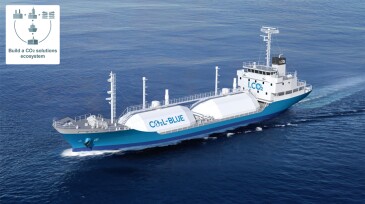
The sites with the most CO2 emissions to capture are often far from the best rock to sequester it, leading to design projects for transport ships.



![JPT_2023-02_GuestEd_Essential-Features-of-the-CO2-EOR-Process[1].jpg](https://assets.spe.org/dims4/default/c0ca44d/2147483647/strip/true/crop/879x491+0+18/resize/365x204!/quality/90/?url=http%3A%2F%2Fspe-brightspot.s3.us-east-2.amazonaws.com%2Fdf%2Fbd%2F1d2a3a144d61b40dbfee45355579%2Fjpt-2023-02-guested-essential-features-of-the-co2-eor-process1.jpg)