Drilling

This paper aims to establish a set of best practices for generating particle-size-distribution data from core samples.

This paper discusses the successful execution of two openhole gravel-pack completions in two Gulf of Mexico fields with depleted reservoirs.

This edition highlights three offshore technology papers that address a common industry theme: how targeted engineering solutions can reduce uncertainty, shorten operations, and make technically constrained offshore well activities more executable.
-
 Examples of evolution in well construction during the past several years include new horizontal-well applications, breakthroughs in bit and directional-drilling technology, synthetic fluids, fracture-stimulation advancements, managed-pressure drilling, and the digital revolution.
 -
Time spent on bottom drilling is only approximately 10% of the time consumed by drilling operations, but this still provides a significant opportunity for savings if it can be reduced.
-
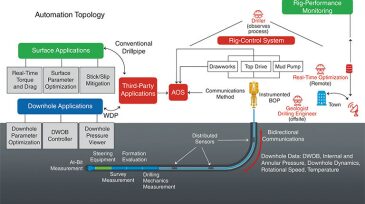
Drilling systems automation requires a digital backbone. One segment of that backbone is the interval between the drill bit and the surface. Wired pipe removes both the bandwidth and latency barriers of the available measurement-while-drilling telemetry systems.
-
In this paper, the application of a real-time T&D model is demonstrated. The process of T&D analysis was automated, and the time and cost required to run physical models offline was reduced or, in some cases, eliminated.
-
Formation damage: Do we always need to have a high focus on its prevention, or do occasions exist when it really does not matter?
-
This paper presents a case history of drilling automation system pilot deployment, including the use of wired drillpipe, on an Arctic drilling operation.
-
This paper describes the progress of directional-drilling-automation systems along the cognitive functions and levels of automation as defined by the Levels of Automation Taxonomy (LOAT) hierarchy introduced by the Drilling Systems Automation Roadmap Industry Initiative.
-
A high-carbon-dioxide (CO2) carbonate gas field offshore Sarawak, Malaysia, is scheduled for development. Reservoirs in this region have an average clay content of 8%; more than 50% of this clay content is migratory illite, and 15% is migratory kaolinite.
-
This paper describes a coreflooding program performed with sandpacks at different permeabilities, water qualities, and injection conditions.
-
Because of inherent complexities, understanding the characteristics of perforations in downhole environments is a significant challenge. Perforation-flow laboratories have been used to provide insight into cleanup and productivity mechanisms around perforation tunnels.