Drilling

This edition highlights three offshore technology papers that address a common industry theme: how targeted engineering solutions can reduce uncertainty, shorten operations, and make technically constrained offshore well activities more executable.

This paper aims to establish a set of best practices for generating particle-size-distribution data from core samples.

This paper discusses the successful execution of two openhole gravel-pack completions in two Gulf of Mexico fields with depleted reservoirs.
-
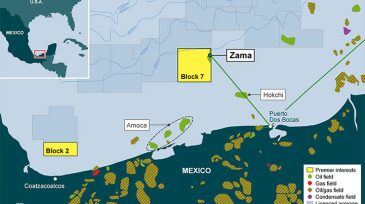
 Finding niches that provide a competitive edge over larger operators has enabled Talos Energy to leapfrog into a powerful position with Mexico’s first offshore wildcat discovery.
 -
In the past, most wells have been drilled using conventional methods, but the landscape is changing as economic pressures have forced the drilling industry to refocus.
-
Bottomhole assemblies (BHAs), as part of the drilling system, have dominating effects on the functionality and effectiveness of other system components. BHA design, usage, and monitoring must promote drilling-system compatibility, efficiency, and reliability.
-
Correct placement of the rotary-speed sweet spot of a bottomhole assembly (BHA) provides multiple benefits toward achieving the ultimate goal of drilling to section total depth in a single trip.
-
Microdoglegs are a natural effect of any vertical or directional well that can explain a wide variety of downhole problems.
-
A new fatigue-management work flow provides drillers with a tool to simulate and predict the life expectancy of bottomhole assemblies (BHAs) before fatigue causes problems.
-
Advancements in extended-reach drilling continue from the ExxonMobil-operated Sakhalin-1 project. The latest “super complex” horizontal well stretches 15,000 m, which partner Rosneft says is a “world record.”
-
Drilling in high-pressure/high-temperature conditions poses numerous challenges. Drilling fluid is subjected to extreme pressure and temperature, and its properties such as viscosity are affected strongly by pressure and temperature. Viscosity decreases with temperature and increases with pressure.
-
The effects of adding iron oxide NPs on the rheological and filtration properties of aqueous bentonite suspensions have been studied by several researchers.
-
Researchers have developed a novel water-based-drilling-fluid system compatible with deepwater HP/HT wells in the Lingshui Block on the basis of a conventional drilling fluid and further optimization.