Drilling

This paper presents the application of degradable particulate-diverter technology to improve oil production by effectively diverting stimulation treatment fluids away from high-water-cut, high-permeability, high-temperature producing intervals or zones.

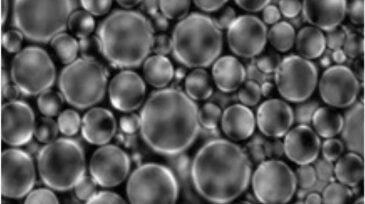
This paper presents the methodology for developing drill-in organophilic clay-free invert-emulsion-fluid technology that enhances well production through fundamental geological studies and fluid testing.

This paper presents the large-scale deployment and operational integration of an advanced, automated rheometer in the Ghawar gas field, one of the world’s most prolific and technically complex hydrocarbon developments.
-
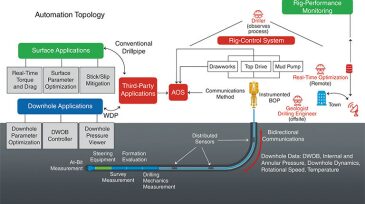
 This paper presents a case history of drilling automation system pilot deployment, including the use of wired drillpipe, on an Arctic drilling operation.
-
This paper describes the progress of directional-drilling-automation systems along the cognitive functions and levels of automation as defined by the Levels of Automation Taxonomy (LOAT) hierarchy introduced by the Drilling Systems Automation Roadmap Industry Initiative.
-
A high-carbon-dioxide (CO2) carbonate gas field offshore Sarawak, Malaysia, is scheduled for development. Reservoirs in this region have an average clay content of 8%; more than 50% of this clay content is migratory illite, and 15% is migratory kaolinite.
-
This paper describes a coreflooding program performed with sandpacks at different permeabilities, water qualities, and injection conditions.
-
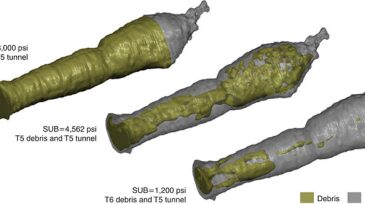
Because of inherent complexities, understanding the characteristics of perforations in downhole environments is a significant challenge. Perforation-flow laboratories have been used to provide insight into cleanup and productivity mechanisms around perforation tunnels.
-
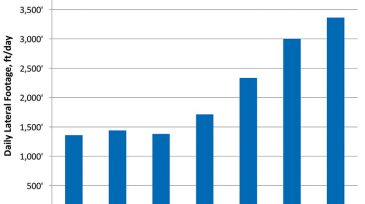
A drilling team has focused on increasing lateral lengths in the Marcellus Shale. The team determined which operational practices would need to be revised in order to drill and case laterals in excess of 18,000 ft.
-
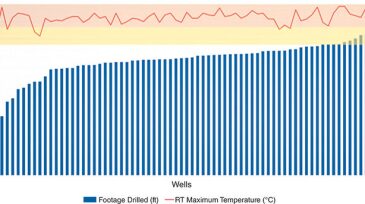
A joint-development project has delivered a high-temperature measurement-while-drilling/logging-while-drilling (MWD/LWD) suite rated for 200°C. Results to date are compared with previous performance in the Gulf of Thailand (GoT).
-
Examples of evolution in well construction during the past several years include new horizontal-well applications, breakthroughs in bit and directional-drilling technology, synthetic fluids, fracture-stimulation advancements, managed-pressure drilling, and the digital revolution.
-
Time spent on bottom drilling is only approximately 10% of the time consumed by drilling operations, but this still provides a significant opportunity for savings if it can be reduced.
-
Falling oil prices are the acid test of drilling efficiency. SPE Technical Director Jeff Moss of ExxonMobil talks about ways to build in lasting savings as part of this special report.