Drilling

This paper presents the application of degradable particulate-diverter technology to improve oil production by effectively diverting stimulation treatment fluids away from high-water-cut, high-permeability, high-temperature producing intervals or zones.

This case study from ARC Resources and DarkVision outlines the use of acoustic imaging tools in two active fracturing programs in Canada to monitor well casing deformation.

Adequate consideration must be given to the potential effect of each fluid on the successive phase operations to ensure integrated well-fluids system management.
-
 To accelerate learning, an operator deployed a real-time, closed-loop downhole automation system (DHAS) in conjunction with wired drillpipe in the 8¾-in.-hole section.
-
This paper presents the LCDSS and elaborates on the use of it in the preparation and training phase and the operational phase, including forecasting.
-
In the Eagle Ford, an integrated approach to engineering and operations was key to optimize performance and improve understanding of the area.
-
Wireline continuous coring (WCC) has been adapted from the mining industry for unconventional resources. This paper is aimed at identifying and addressing complications experienced in the use of WCC.
-
A number of companies are pushing for alternative approaches to offshore development that seek to access marginal reservoirs. Their differing and unique ideas call for a departure from the usual playbook, but share a common goal of slashing capital costs.
-
Precise casing-wear prediction is important for improving well integrity and longevity, while simultaneously making casing designs more cost-effective. There are no industry guidelines for casing-wear prediction. This article presents a validated predictive model.
-
This paper analyzes differing well-factory approaches to unconventional assets, with examples from the Wolfcamp unconventional oil play in the Permian Basin.
-
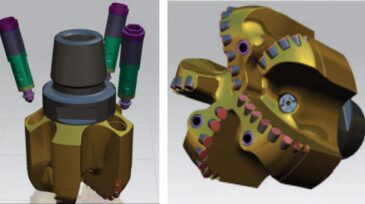
Baker Hughes is developing a drill bit capable of auto-adjusting its depth-of-cut feature to handle dynamic drilling conditions.
-
Anyone selling something new for offshore exploration and production has to be able to answer a simple question from customers, “How can we save some money?” For Norwegian oil companies, change is coming in many forms: steel, sensors, software, and standards.
-
Challenging environments such as unstable clay formations represent high operational risk when running tubulars after drilling is completed.