Drilling

As Egypt’s largest oil and gas investor, Eni is ramping up its 2026–2027 drilling campaign with new investments cross the Mediterranean offshore, Nile Delta, Western Desert, and offshore Sinai to strengthen the country’s role as a regional gas and LNG export hub.

The deals, with a potential value exceeding $3.7 billion, are aimed at strengthening Saudi Aramco’s supply chains and expanding its use of industrial artificial intelligence.

Brownfield redevelopment and new exploration projects could lift Venezuelan output above 2 million B/D by next decade.
-
 The general industry perception is that, when drillstrings or casing strings exceed conventional helical-buckling criteria, they cannot be operated safely in the hole because the risk of failure or lockup is too high.
 -
The producing assets of unconventional shale-gas and shale-oil plays in North America are among the strategic alternatives for future growth of exploration-and-production companies.
-
ExxonMobil, operator for the Sakhalin-1 project, planned an additional drilling campaign at the Chayvo field, Sakhalin Island, Russia.
-
In 2012, the number of unconventional tight gas/shale and high-pressure/high-temperature (HP/HT) papers continued to grow. This year, we had some very interesting developments in these and other areas of well construction.
-
This case history presents the highly challenging extended-reach deepwater well, Ursa A-10, drilled in the Ursa (Latin for bear) prospect in the US Gulf of Mexico (GOM).
-
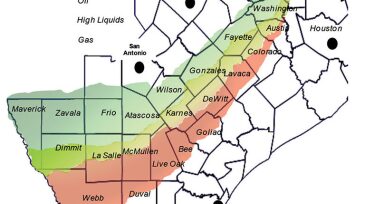
The Eagle Ford shale in Zavala County, Texas, is similar to many high-carbonate-content oil-shale formations.
-
To maintain zonal isolation throughout the life of a high-pressure/high-temperature (HP/HT) well, the cement sheath must perform reliably at temperatures that can exceed 315°C.
-
The Granite Wash formation presents several challenges in drilling the build section from a vertical open hole to form a lateral.
-
As operators continue to drill into deeper and more-extreme formations, the demand for technologies suited to these environments increases.
-
With exploration in harsh environments and consequent high-pressure and high-temperature conditions, calculating reservoir properties has become complex and changes in pressure-transient response need to be understood and appreciated by taking appropriate measures.