Enhanced recovery

A refined laboratory method challenges long-held assumptions about inaccessible pore volume (IAPV) in polymer flooding. Results suggest that, in higher-permeability rocks, much of the reported IAPV may stem from measurement limitations rather than true polymer exclusion.

Coreflood experiments reveal that alkali significantly reduces viscosity loss in polyacrylamide flooding systems by minimizing adsorption and improving polymer stability under shear stress. The findings position viscosity retention as a key screening criterion for successful alkali-polymer enhanced-oil-recovery applications.

This study investigates the potential for in-situ hydrogen generation from hydrocarbons using in-situ combustion, with particular emphasis on the role of kerogen content and heating mode.
-
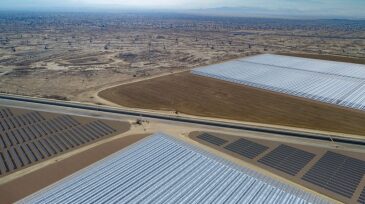
 If proven economic, solar EOR technology could represent an environmentally and energy friendly solution for California’s heavy oil producers.
-
Early field tests suggest chemical treatments may be able to significantly increase production from unconventional formations.
-
The promise of getting 30% more oil production from shale wells has set off a race by companies trying to see if they can replicate what EOG has done. But the big question is: Can it add enough oil to increase the industry’s low average recovery rate?
-
Currently, there are few studies on smart waterflooding in tight and very tight oil reservoirs. This work examines smart-waterflood opportunities in such reservoirs.
-
Previous studies demonstrate that Montney rock samples present a dual-wettability pore network. Recovery of the oil retained in the small hydrophobic pores is uniquely challenging.
-
This paper presents the performance results from one of the waterflood pilots in the Viewfield Bakken.
-
This paper discusses a crestal gas-injection project that was carried out in a supergiant heterogeneous-carbonate oil field.
-
The authors discuss a new way of extracting deformation information from radar imagery, contributing to improved accuracy of InSAR surface-elevation monitoring.
-
Global emissions of CO2 resulting from the use of fossil fuels amount to approximately 35 billion tons/yr. How much of this can we capture? How much can we store or sequester? And, perhaps the most important question: How much will it cost and who will pay?
-
An operator has designed a demonstration project for carbon dioxide (CO2) enhanced oil recovery (EOR) and has implemented it in one of its fields.