Enhanced recovery

SPE Journal is seeking submissions for a special issue on sustainable enhanced oil recovery (EOR), highlighting innovations that boost oil recovery while reducing CO2 emissions and environmental impact. The Call for Papers opens on 15 October 2026.

By integrating experimental and mathematical modeling approaches, this work aims to advance the understanding of sand-detachment dynamics and formation instability under varying saturation conditions.

As Egypt’s largest oil and gas investor, Eni is ramping up its 2026–2027 drilling campaign with new investments cross the Mediterranean offshore, Nile Delta, Western Desert, and offshore Sinai to strengthen the country’s role as a regional gas and LNG export hub.
-
 This is the most exciting time for enhanced oil recovery (EOR) in recent memory. At last, almost everyone is talking about increasing recovery factors, and improved oil recovery (IOR) and EOR are being considered natural components of reservoir management.
 -
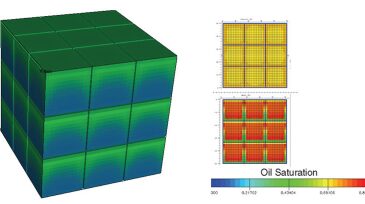
Foam simulation brings various numerical challenges. Some of these problems are largely cosmetic.
-
This paper discusses the process undertaken by the Clair Ridge project in getting RS enhanced oil recovery (EOR) adopted as a Day-1 secondary waterflood.
-
Factors such as hydraulic gradients in the horizontal completion, geologic and fluid variations in the reservoir, and well-placement issues can produce very poor steam conformance in steam-assisted gravity drainage (SAGD).
-
Naturally fractured reservoirs (NFRs) contain a significant amount of remaining petroleum reserves and are now being considered for water-alternating-gas (WAG) flooding as secondary or tertiary recovery.
-
A carbonate field developed by Petroleum Development Oman is one of the largest fields in the Sultanate of Oman and has been running for more than 4 decades.
-
A variety of low-cost technologies can result in an increase in production in mature oil and gas fields, although the increase is usually temporary and not always economical.
-
The evaluation of complex carbonate reservoirs is a challenging task, and a detailed understanding of reservoir heterogeneity is still lacking. In this study, the effect of static rock type and sample size was investigated on special-core-analysis laboratory (SCAL) data derived from capillary pressure and resistivity-index experiments at reservoir temperature and net …
-
Accurate determination of relative permeability hysteresis is needed to predict water-alternating-gas (WAG) injection reliably. Two series of gas/water relative permeability hysteresis curves were obtained from corefloods under mixed-wet conditions. The results revealed that none of the widely used hysteresis models (e.g., Carlson and Killough models) is able to predi…
-
The M4-field reservoir is approximately 2000 m below sea level in a water depth of approximately 120 m. A carbon dioxide (CO2) geological-storage study was carried out to determine the feasibility of injecting and storing CO2 in the depleted M4 carbonate gas reservoir.