Formation damage

This paper presents laboratory-testing methods and evaluation criteria designed to improve understanding of both the origin and extent of formation damage associated with CO2 injection.

This work introduces an analytical model for nonisothermal CO2 injection that accounts for both Joule-Thomson cooling and interformation heat exchange.
This paper describes development of a high-temperature water-based reservoir drill-in fluid using a novel synthetic polymer and customized with optimal chemical concentrations and sized calcium carbonate.
-
 The complete paper presents a numerical work flow to simulate the effect of flow-induced fines migration on production decline over time in deepwater reservoirs.
 -
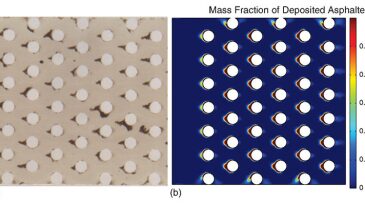
Asphaltene precipitation and deposition in production tubing and surface facilities are well-documented issues, and different methods are available to manage them.
-
One of the challenges for those involved with understanding an unexpected decline in well performance is identifying the exact causes for the reduced productivity. Consideration of all data available can eventually point toward one factor that could explain productivity decline.
-
Understanding of formation damage is a key theme in a waterflood project. An integrated multidisciplinary approach is required to determine an optimal design and strategy.
-
The paper describes a novel methodology to construct distributed formation damage across openhole wells in carbonate reservoirs and to evaluate the effects of damage on zonal productivity.
-
This paper summarizes a wide variety of sandstone-acid-stimulation case histories, highlighting aspects such as mechanical conditions and operational practices.
-
The wireline formation tester (WFT) is a well-developed technology used to collect representative downhole fluid samples. The authors introduce a simple but effective method for monitoring WFT sampling when targeting the low levels of contamination needed for asphaltene-onset-pressure analysis.
-
This paper focuses on experimental methods quantifying water-based muds and investigating effects on particle bridging, filtrate invasion, and permeability.
-
Well-control fluids were used during a routine overbalanced workover operation in an offshore well completed in high-permeability sandstone.
-
A challenge in many permeable, water-sensitive, subhydrostatic reservoirs is avoiding the loss of completion fluid when completing or working over wells.