Fracturing/pressure pumping

This article from the SPE Research and Development Technical Section offers new insights to how the upstream industry can benefit from the emergence of quantum computing.

This contributed article highlights the growing importance of fiber-optic sensing and its potential to advance thanks to emerging quantum technologies.

This case study presents the first field deployment of acoustic fracturing analysis to evaluate perforation efficiency and implement real-time interventions during pressure pumping.
-
 While shale unproved technically recoverable resources have been identified around the world, development has been limited to North America.
 -
At the 2014 SPE Hydraulic Fracturing Technology Conference in February, former Texas A&M Department of Petroleum Engineering head Stephen A. Holditch received a well-deserved lifetime achievement recognition, the Legends of Hydraulic Fracturing Award.
-
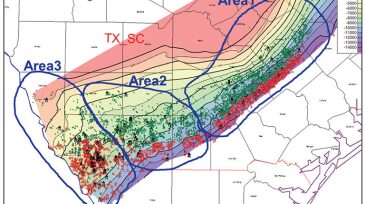
The purpose of this paper is to apply multivariate statistical modeling in conjunction with geographic-information-systems (GIS) pattern-recognition work to the Eagle Ford.
-
Production from the Bakken and Three Forks formations within the Williston basin is continuing to climb as a result of applied horizontal drilling and hydraulic fracturing.
-
Using large-scale hydraulic-fracturing experiments on tight shale outcrops, three dominant regions controlling stage production were identified.
-
An analysis of thousands of fracturing treatments in major plays in the United States provides insights into how fracture designs have changed over time.
-
Fiber optic pressure and temperature (P/T) sensing technology for multizone fracturing and production monitoring is enabled by a new feed-through (FT) technology that integrates the optical fiber within the multiple elastomer elements of a compact, swellable openhole packer system.
-
The demands for the fresh water used in many hydraulic fracturing operations are placing pressure on water sources in some regions of the United States. Because of the high volumes of water needed for fracturing and competing demands availability of fresh water has decreased and costs have grown.
-
This is the fifth article in a series covering water management in hydraulic fracturing in unconventional resources. The focus of this article is biological control. Additives to improve fracturing conditions can have negative effects on water treatment.
-
Seizing on historic margins in domestic prices, North American oil and gas companies are increasing their efforts to use more natural gas and less diesel fuel to power their field operations.