Fracturing/pressure pumping

The Houston-based enhanced geothermal developer scored $1.9 billion in an initial public offering, positioning it to expand projects in Utah and Nevada.

A Chinese operator in the Sichuan Basin used high‑frequency pressure monitoring to evaluate frac performance in unconventional wells.

Hydraulic fracturing holds great potential in the region, but there are several key questions worth asking as efforts move forward.
-
 For those in shale exploration, “fracability” is a real word, a critical property, and a point of contention.
 -
With inconsistent inlet water quality being the rule rather than the exception, sizing and operational considerations of the treatment system components must vary accordingly to make the most economic sense.
-
While shale unproved technically recoverable resources have been identified around the world, development has been limited to North America.
-
Some operators are returning to their North American mature unconventional shale wells to refracture, or restimulate, the rock to accelerate production and enhance ultimate recoveries.
-
At the 2014 SPE Hydraulic Fracturing Technology Conference in February, former Texas A&M Department of Petroleum Engineering head Stephen A. Holditch received a well-deserved lifetime achievement recognition, the Legends of Hydraulic Fracturing Award.
-
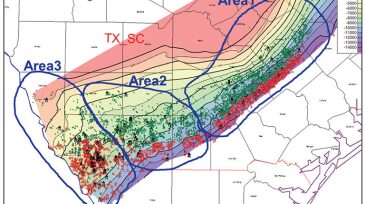
The purpose of this paper is to apply multivariate statistical modeling in conjunction with geographic-information-systems (GIS) pattern-recognition work to the Eagle Ford.
-
Production from the Bakken and Three Forks formations within the Williston basin is continuing to climb as a result of applied horizontal drilling and hydraulic fracturing.
-
Using large-scale hydraulic-fracturing experiments on tight shale outcrops, three dominant regions controlling stage production were identified.
-
An analysis of thousands of fracturing treatments in major plays in the United States provides insights into how fracture designs have changed over time.
-
Fiber optic pressure and temperature (P/T) sensing technology for multizone fracturing and production monitoring is enabled by a new feed-through (FT) technology that integrates the optical fiber within the multiple elastomer elements of a compact, swellable openhole packer system.